

Don't wait for a water crisis to act. Proactive utilities reinvest and strengthen their infrastructure before it breaks.
knowledge exchange
The case for community reinvestment

Key points
- Aging water systems are becoming a community risk. Cybersecurity threats, deferred maintenance, and failing underground infrastructure show why reinvestment in drinking water can no longer be delayed.
- The largest costs are buried underground. Distribution and transmission systems account for the biggest share of drinking water investment needs, with aging mains, service lines, valves, pumps and related assets driving repair and replacement costs.
- The funding burden has shifted locally. Reduced federal support, higher borrowing costs, regulatory resistance to rate increases, and household affordability limits are forcing state and local governments, utilities and consumers to shoulder more of the reinvestment challenge.
- Community buy-in and strategic collaboration is the path forward. Utilities that make infrastructure risks visible, prioritize high-consequence assets, align projects with financing tools and collaborative partnerships, and communicate the value of reinvestment can build support for more sustainable water systems.
When deferred maintenance becomes a community risk
Reporting in The New York Times links recent cyberattacks on U.S. water systems to long-standing warnings about aging infrastructure, weak cybersecurity and chronic underinvestment. It shows how deferred maintenance and limited resources can expose essential utilities to both physical and digital risks, raising an urgent question of just how vulnerable are our water systems?
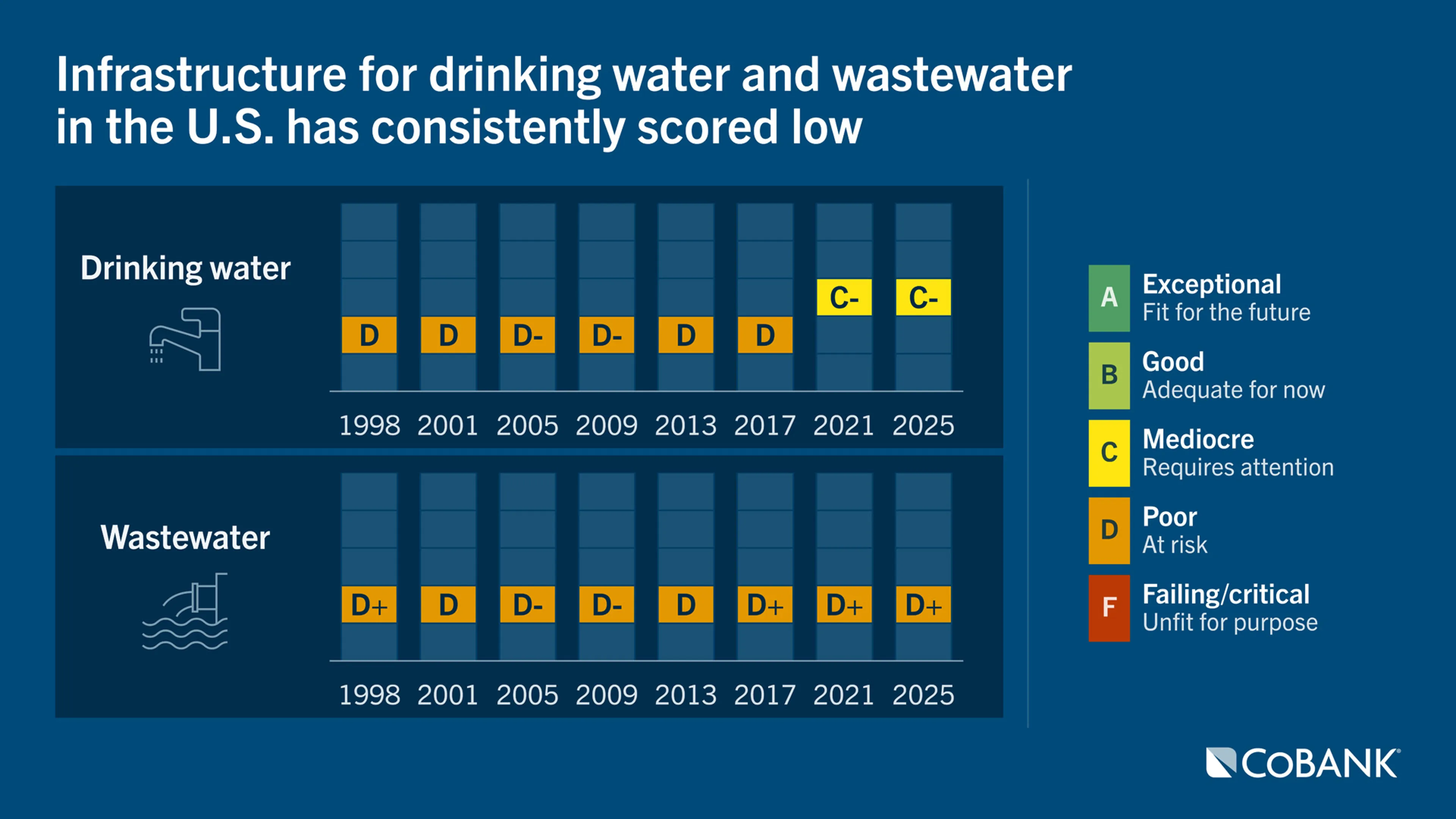
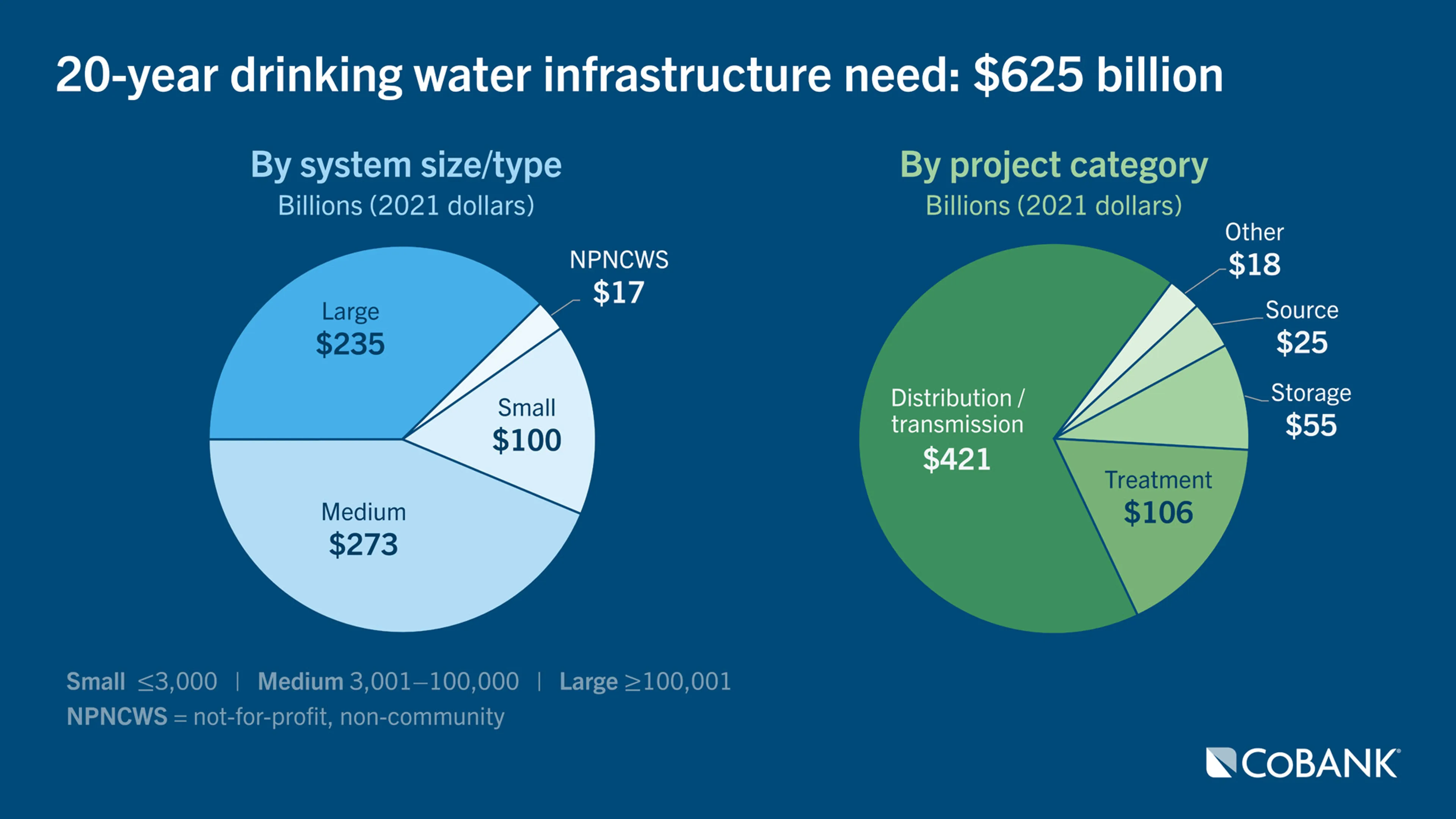
According to the American Society of Civil Engineers, our water systems are in pretty bad shape. Its 2025 Report Card for America's Infrastructure gives U.S. drinking water a C- and wastewater a D+, signaling that essential water systems remain aging, underfunded and increasingly costly to operate. What’s more, the scale of the gap is substantial; the Environmental Protection Agency estimates drinking water infrastructure needs at least $625 billion over 20 years, while ASCE estimates wastewater and stormwater capital needs today exceed available funding by $69 billion annually, and could widen to more than $690 billion by 2044 if current trends continue. In other words, delaying reinvestment is no longer a low-cost option. The cumulative effects of deferred maintenance are becoming more expensive and more visible in the communities that depend on these systems.
For drinking water systems specifically, the largest investment need is buried underground. EPA’s latest needs assessment shows that water distribution and transmission systems account for about $421 billion of the 20-year need, far exceeding treatment plant upgrades at roughly $106 billion and storage assets at about $55 billion. Within water distribution and transmission systems, the largest costs are associated with repairing or replacing aging mains, service lines, valves, pumps, and related components because these assets are extensive, often decades old, difficult to access and expensive to excavate and restore once they begin to fail. From a system-size perspective, the largest dollar need sits with medium and large community water systems, but small systems often face the greatest affordability and capacity constraints, making targeted support essential for communities least able to finance upgrades on their own. Moreover, smaller-system needs may be undercounted because survey-based assessments depend on documented projects and available system data, which can miss infrastructure that has not been fully inventoried, engineered or costed.
The data point to a clear conclusion: The nation’s drinking water challenge is concentrated in aging underground networks that are costly to locate, excavate, repair, and replace, with small and resource-constrained systems facing the greatest affordability and execution risks. Yet the scale of this need has not been matched by available funding, as responsibility has shifted increasingly to state and local sources amid reduced federal support, a tougher credit environment, regulatory resistance to rate increases, and consumers who may lack either the willingness or the ability to absorb higher water bills.
The money problem
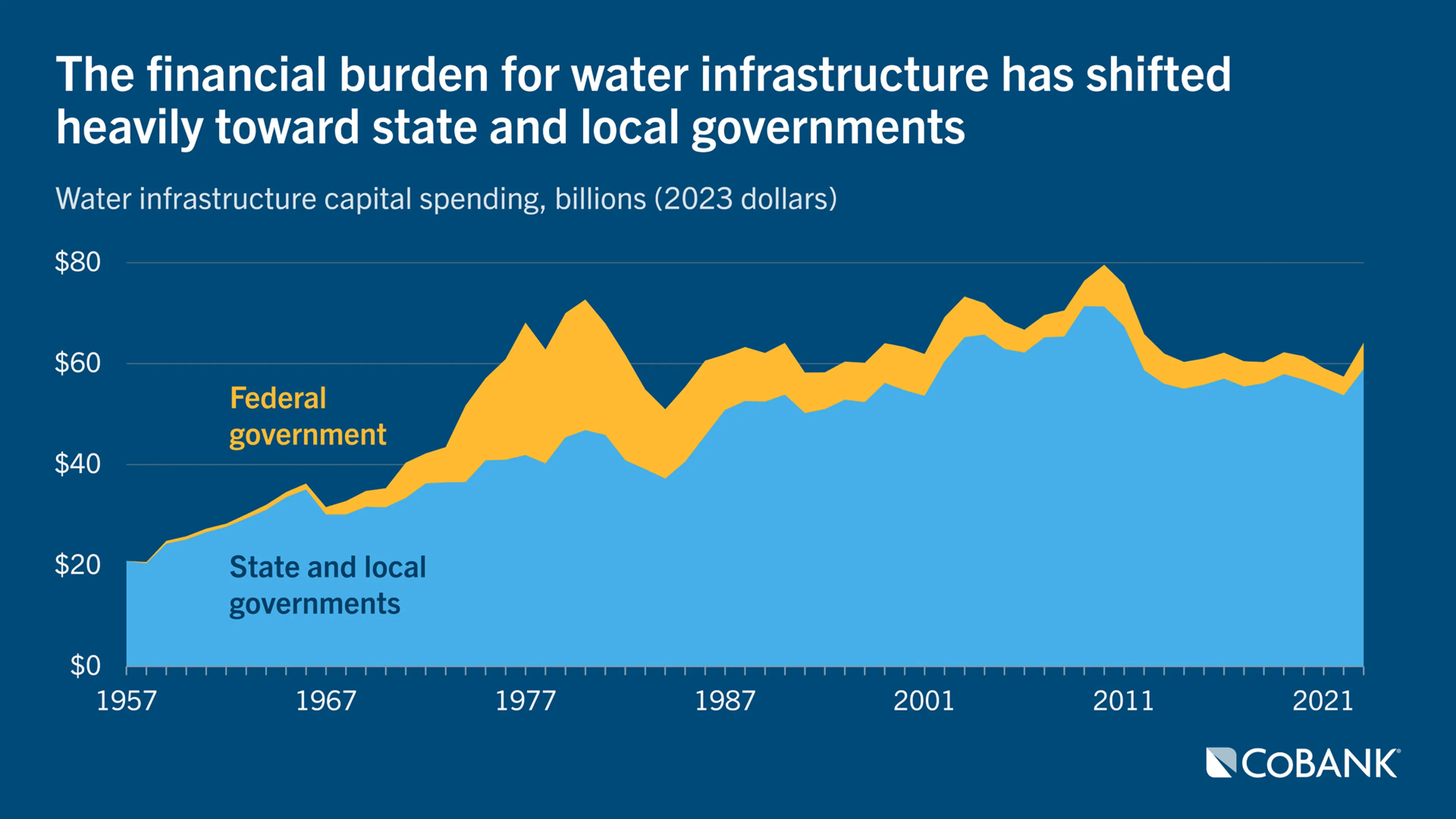
One reason the funding gap has persisted is that the financial burden for water infrastructure has shifted heavily toward state and local governments. CBO data show that in 2023, the most recent year for which data are available, the state and local share of such spending was 92%, while the federal share was 8%. This marks a historic shift in that federal grants once covered as much as 75% of eligible local wastewater construction costs under the 1972 Clean Water Act program, whereas today state and local governments fund nearly four-fifths of combined transportation and water infrastructure spending and almost all water-utility spending. The result is that large, long-lived assets are increasingly being financed through local rates, municipal debt, and state revolving fund programs rather than broad-based federal support.
That shift is occurring at a difficult point in the asset cycle. Many water systems are no longer expanding to serve new growth as much as they are replacing buried infrastructure installed decades ago — while also absorbing new regulatory requirements tied to lead service lines, PFAS and other emerging contaminants, water quality monitoring, resilience and cybersecurity. These obligations increase both capital and operating costs, meaning utilities must fund replacement of existing assets while also meeting higher standards for safety, reliability and compliance.
The financing environment has also become less forgiving. Higher interest rates, construction-cost inflation, and rising costs for labor, chemicals, equipment, and imported materials have increased the cost of issuing debt and delivering projects, even for utilities with historically stable revenue profiles. Rating agencies have flagged these pressures. While it has since updated its outlook to "neutral," Fitch revised its U.S. water and sewer sector outlook to "deteriorating" in June 2025 amid rising costs and federal-policy uncertainty, while S&P has noted that its downgrades and unfavorable outlook revisions have been driven by deteriorating liquidity and growing capital needs.
Even when utilities can document the need for higher spending, rate recovery is not automatic. Regulators may be reluctant to approve the full rate increases requested by investor-owned water companies or municipally governed utilities when household bills are already rising, using rate-case decisions or local political pressure to moderate the near-term impact on consumers. That approach can protect affordability in the short run, but it can also delay cost recovery and push needed investment further into the future.
At the root of the problem is a public willingness-to-pay challenge. Water systems depend on consumers to finance reinvestment through bills, but the benefits of replacement are often invisible until a main breaks, a service line fails, or water quality is threatened. For many households, the issue is not only willingness but ability, especially as water and sewer bills have risen faster than general inflation and low-income assistance remains limited.
Communities choosing to reinvest
For water utility executives, this landscape can understandably feel debilitating. More to the point, the needs are large, the rate path is constrained and the assets most in need of replacement are often the least visible to customers.
Several high-profile failures illustrate the consequences of delaying reinvestment in safe drinking water. The lead contamination and water-borne disease affecting Flint, Michigan 2014-2019, exposed how aging infrastructure, flawed decision-making, and inadequate safeguards can quickly become a public-health crisis. The 2022 flooding of the Jackson, Mississippi, treatment plant similarly demonstrated how decades of deferred maintenance and recurring service disruptions can undermine system reliability and public confidence. These cases underscore that water infrastructure underinvestment is not only a financial issue. But rather, it is a governance, public-health and community-resilience risk.
Still, there are hopeful examples of communities turning that challenge into a reinvestment strategy. The following examples draw on the National League of Cities’ recent recognition of the Lead Service Line Replacement Collaborative’s decade of local leadership. That work highlights how communities are converting the complex task of lead service line replacement into practical strategies for public-health protection, equitable access, customer engagement, financing, and long-term system reinvestment.
- Washington, D.C.: DC Water’s Lead Free DC initiative shows how a utility can turn a regulatory and public-health challenge into a visible community reinvestment program. Launched in 2019, the effort aims to replace about 42,000 lead or galvanized service lines with copper pipes and had completed its 10,000th replacement by fall 2025, while also using paid Community Activators to increase homeowner participation and support local workforce development.
- Grand Rapids, Michigan: The Grand Rapids Water System demonstrates the importance of customer engagement in moving lead service line replacement from policy goal to household action. Its program uses multi-channel outreach to secure property-owner agreements and customer feedback surveys after replacements to improve the experience and build trust in the process.
- St. Paul, Minnesota: St. Paul Regional Water Services’ Lead Free St. Paul program demonstrates how a utility can pair infrastructure renewal with equity and implementation capacity. The utility is working to replace roughly 29,500 lead or unknown service lines over 10 years, with an emphasis on equitable access to replacement and related employment opportunities. The program illustrates how local utilities can connect public-health protection with broader community benefits.
Local elected officials are essential to maintaining support for water infrastructure investment. Utilities should involve mayors, council members, county officials, and other trusted voices early to frame projects as community priorities, not merely engineering or rate-setting decisions. These leaders can explain public-health and reliability risks, connect projects to local needs, support outreach, assist with funding and technical coordination, and show that planned reinvestment costs less than emergency repairs after failures.
These examples suggest that progress is most likely when utilities make the problem visible, connect investment to tangible public-health and reliability outcomes, and reduce barriers for customers and smaller systems that cannot move forward on their own. The recommendations that follow build on those lessons by focusing on how water utilities can strengthen community buy-in, explain the cost of inaction, prioritize limited dollars, and align financing tools with the customers and assets most at risk.
From buy-in to buildout: 5 ways to move water investment forward
Valuing water before it breaks means treating reinvestment as a community resilience strategy, not simply a utility capital plan. In response to the vulnerabilities highlighted by The New York Times — where aging infrastructure, weak cybersecurity, and years of underinvestment left water systems exposed — the path to fortifying vulnerable systems begins with making the risks visible, aligning communities around the cost of inaction, and directing scarce dollars toward the assets most essential to safe, reliable service.
- Make the invisible system visible. Utilities can build traction by translating buried infrastructure risk into plain-language impacts that customers and local leaders can understand: water-main breaks, boil-water notices, service disruptions, compliance risks, and rising emergency-repair costs. Communicating the cost of inaction helps shift the conversation from “why are rates rising?” to “what risks are we buying down?”
- Prioritize the assets with the highest risk and highest consequence of failure. Limited dollars should be guided by asset condition, break history, water-loss data, public-health exposure, regulatory deadlines, and the number of customers affected by a potential failure. In practice, that often means focusing first on aging distribution and transmission mains, lead or galvanized service lines, critical valves and pumps, and infrastructure serving hospitals, schools, major employers, and dense residential areas.
- Match the project to the financing tool. Utilities should distinguish between projects that can be supported through rates, those that require debt financing, and those that need grants, principal forgiveness, or state revolving fund support to remain affordable. This is especially important for small and disadvantaged communities, where predevelopment funding, engineering support, and grant-matching assistance can determine whether a high-priority project ever becomes financeable.
- Build a communication program before the rate case or bond vote. Community buy-in is more likely when utilities engage early, consistently, and locally through town halls, customer newsletters, bill inserts, social media, neighborhood meetings, school and health partnerships, and direct outreach to affected customers. The most effective messages connect investment to outcomes people value — safe drinking water, fewer disruptions, stronger fire protection, economic development, and intergenerational stewardship — while being transparent about bill impacts and affordability protections.
- Plan for sustainability through collaboration, not just compliance. Long-term planning should link capital improvement plans, asset management, rate design, affordability programs, climate resilience, workforce capacity, and regulatory compliance into a single reinvestment roadmap. For small and rural systems in particular, that roadmap might include voluntary, community-led collaboration with neighboring utilities, trusted technical assistance providers, local partners, and financial institutions that understand the long-term capital needs of essential infrastructure. As the National Rural Water Association and Rural Community Assistance Partnership emphasize in their Regional Partnership Program: A Community-Led Approach white paper, “regional partnerships are most effective when they help communities share expertise, services, purchasing power, planning capacity, and investment strategies while preserving local governance, community identity, and public accountability”. By sequencing projects over decades, updating rates gradually, pursuing outside funding early, reporting progress back to the community, and evaluating partnership opportunities where they strengthen technical, managerial, or financial capacity, utilities can turn episodic crisis spending into a durable strategy for reliable and affordable water service.
The information provided in this report is not intended to be investment, tax, or legal advice and should not be relied upon by recipients for such purposes. The information contained in this report has been compiled from what CoBank regards as reliable sources. However, CoBank does not make any representation or warranty regarding the content, and disclaims any responsibility for the information, materials, third-party opinions, and data included in this report. In no event will CoBank be liable for any decision made or actions taken by any person or persons relying on the information contained in this report.