
AI-led jobs “apocalypse” looks increasingly unlikely


Key points
- Nearly four years after generative AI was rolled out to the public, little evidence suggests it has caused a significant decline in overall demand for workers.
- Productivity gains have yet to reach the bottom line of most organizations. Rather, AI has boosted productivity for specific tasks, prompting employers to redesign jobs and retrain workers rather than eliminate positions.
- Our base case for AI’s ultimate effect on the labor market remains gradual adoption of the technology over time without major associated job losses.
A year ago, we examined whether artificial intelligence was reducing employers’ demand for recent college graduates and found limited impact. Now, nearly four years after ChatGPT became publicly available and businesses began widely adopting AI, we can draw firmer conclusions about how AI will affect the broader labor. Most importantly, little evidence suggests AI is causing a broad decline in worker demand across occupations or demographic groups. This does not mean AI has no effect. So far, it is changing workers’ tasks more than eliminating their jobs.
AI adoption is broad but shallow
AI adoption has spread rapidly beginning in early 2023, such that three years later 47% of workers say their organization has adopted AI and over half are using it on the job to some degree, according to Gallup. However, adoption remains relatively shallow. In most occupations, workers use AI for selected activities such as gathering information, drafting material, analyzing data, or writing computer code. A recent study by Federal Reserve Bank of St. Louis economists found that while more than 40% of tasks have adoption above 20%, fewer than 3% of tasks have adoption above 50%, and no task has adoption above 70%. In other words, workers are using AI across many tasks, but it rarely performs most of any one task.
So, few occupations have reached the point where AI can reliably perform the complete set of tasks required of a worker. This distinction matters because almost all jobs require a variety of skills and capabilities to complete many different tasks. AI may perform part of a financial analyst’s research, for example, without replacing the analyst’s judgment, accountability or communication with clients. It may help a technician diagnose a problem while leaving the physical repair to the worker. As a result, employers have generally focused on redesigning jobs and training existing employees rather than eliminating entire positions.
Employer surveys show that AI is changing jobs more often than eliminating them. Relatively few businesses report layoffs directly attributable to AI. More firms report that they are retraining employees, changing job responsibilities or seeking applicants who can use AI effectively. Other surveys, such as McKinsey’s, show that companies’ predictions of AI-related job losses have largely failed to materialize.
Productivity gains have yet to reach the bottom line
Perhaps the most interesting finding in the flood of recent AI studies is that gains are more apparent for worker-level productivity than in companies’ financial results. Many employees say AI helps them complete tasks more quickly and make better decisions. Yet only a minority of companies report a significant improvement in profits. Time saved by an individual employee does not automatically reduce costs or increase revenue. Speeding up one part of the workflow does not necessarily translate into speeding up the entire workflow.
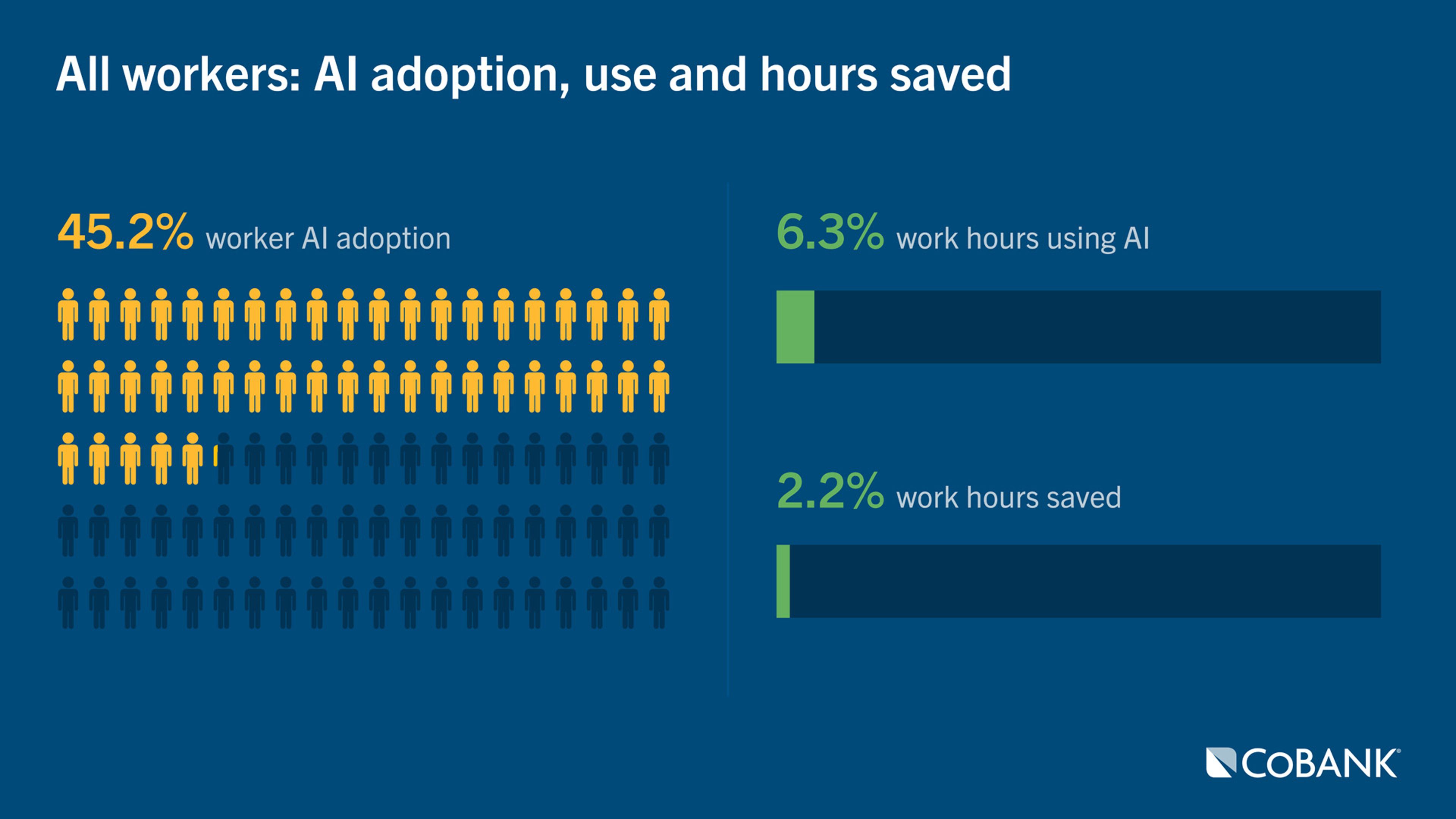
McKinsey’s survey showed that 80% of respondents using AI reported higher personal productivity. While 37% of respondents attribute at least some EBIT impact to AI use, only 6% reported “significant value” (defined as 5% of EBIT attributable to AI). The Project on Workforce at Harvard’s GenAI Adoption Tracker paints a similar picture of modest gains. Data from May shows just over 45% of workers overall used genAI for work. On average, they spent 6.3% of total work hours using genAI and saved 2.2% of total work hours.
For the labor market, this creates an important middle ground between “AI changes nothing” and “AI will eliminate millions of jobs.” Firms may retain their current employees while hiring fewer additional workers than they otherwise would. Positions may disappear through attrition or never be posted in the first place.
Entry-level workers face greater risk
Recent college graduates have been finding it harder to enter their chosen fields since at least 2018, and AI may reinforce this problem. The gap between the unemployment rate for recent college graduates and the overall general U-4 unemployment rate is increasing.
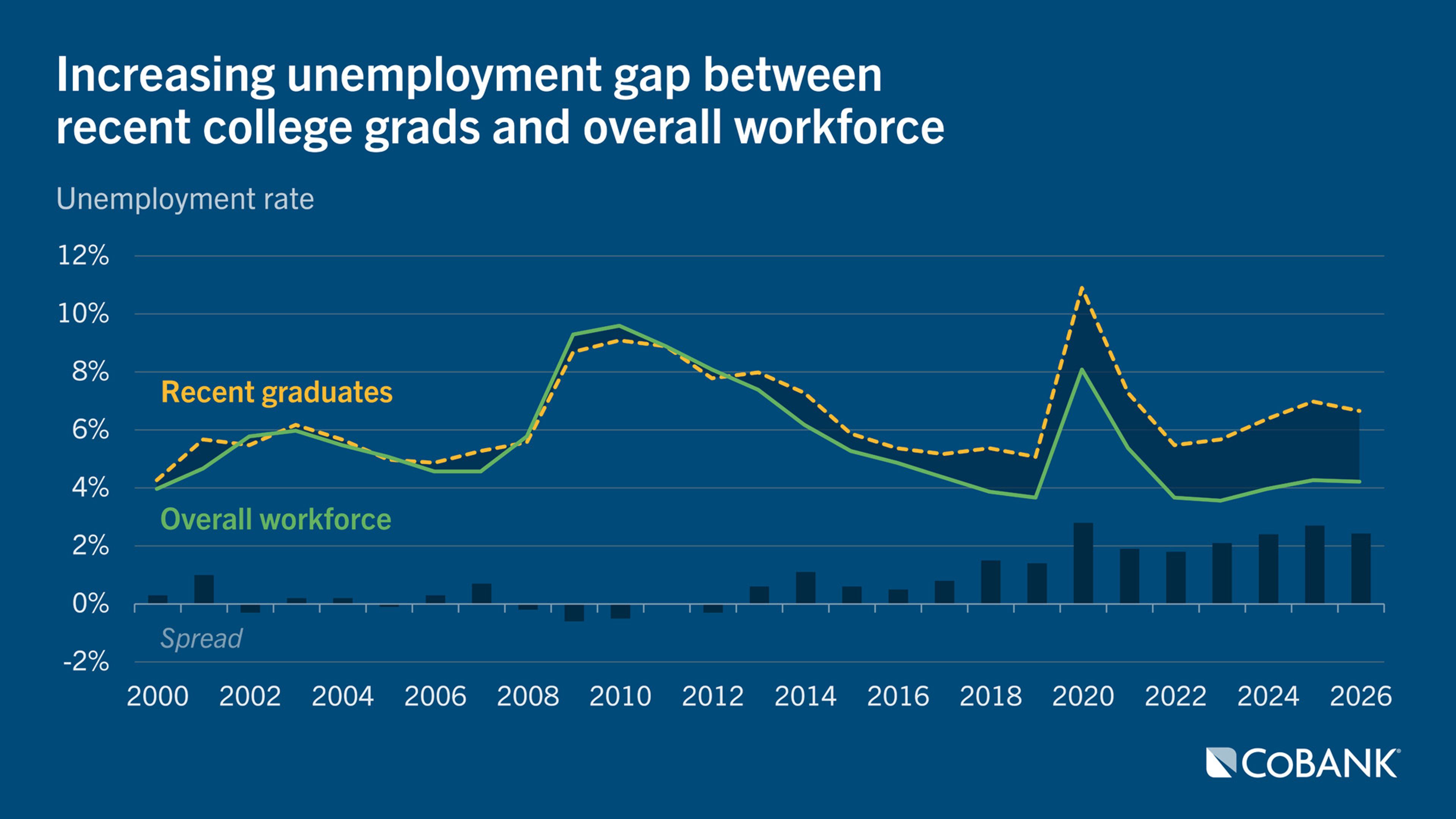
Existing employees have firm-specific knowledge, access to internal data, and opportunities to learn AI within actual workflows. Employers can train these workers and use AI to increase their capacity. New graduates lack that organizational context and may find it harder to obtain the first job needed to develop it. The near-term risk may therefore be a weakening of the first rung of the career ladder rather than a wave of unemployment among established professionals.
AI-related displacement risks also extend to millions of clerical and administrative workers. A recent study by the Brookings Institution estimated that 6.1 million jobs are at risk of displacement. Those jobs have limited transferable skills and include office clerks, receptionists, payroll clerks and medical secretaries, among others. Brookings estimates that 86% of these positions are held by women. Geographically, these workers are concentrated in smaller metropolitan areas, putting rural areas at more risk due to fewer nearby employment options.
Evolution, not disruption, remains the base case
Our base case remains gradual adoption without major associated job losses. AI use will deepen as workers learn where it is reliable and companies reorganize around it. Productivity should improve, but implementation costs, organizational inertia, legal constraints and the continuing need for human judgment will slow the transition. Rather than sudden economywide displacement, employment will likely change more through shifts in the mix of occupations and hiring that grows more slowly than output. For now, however, the evidence points to evolution before disruption. AI will reshape occupations and curb hiring before it causes widespread displacement, with entry-level workers in vulnerable fields facing the greatest near-term risk.
Disclaimer: The information provided in this report is not intended to be investment, tax, or legal advice and should not be relied upon by recipients for such purposes. The information contained in this report has been compiled from what CoBank regards as reliable sources. However, CoBank does not make any representation or warranty regarding the content, and disclaims any responsibility for the information, materials, third-party opinions, and data included in this report. In no event will CoBank be liable for any decision made or actions taken by any person or persons relying on the information contained in this report.