
Fixing America’s grid logjam: FERC is pressing grid operators to move faster as power demand surges

Key points
- The Federal Energy Regulatory Commission is addressing the grid interconnection slowdown from both directions: implementing generation reforms under Order 2023 and requiring regional grid operators to speed connection for new large loads under Section 206.
- Faster studies can reduce process delays and identify viable projects sooner, but approval to connect does not guarantee that a new power plant will be financed, permitted or built.
- The larger challenge is aligning interconnection reform with transmission development, generation investment, permitting and cost allocation.
Thousands of generation and storage projects are waiting to connect to the electrical grid. Regional transmission organizations and independent system operators must study each proposed project to identify necessary system upgrades, determine their cost and decide who should pay for them. But the process was developed in a slower era and is now straining under the weight of pressure from a much larger volume of proposed generation, energy storage, and new electricity demand. Rapid growth in data centers and other large loads is likewise creating a parallel demand-side bottleneck, much like the congestion that has overwhelmed ISO generation queues.
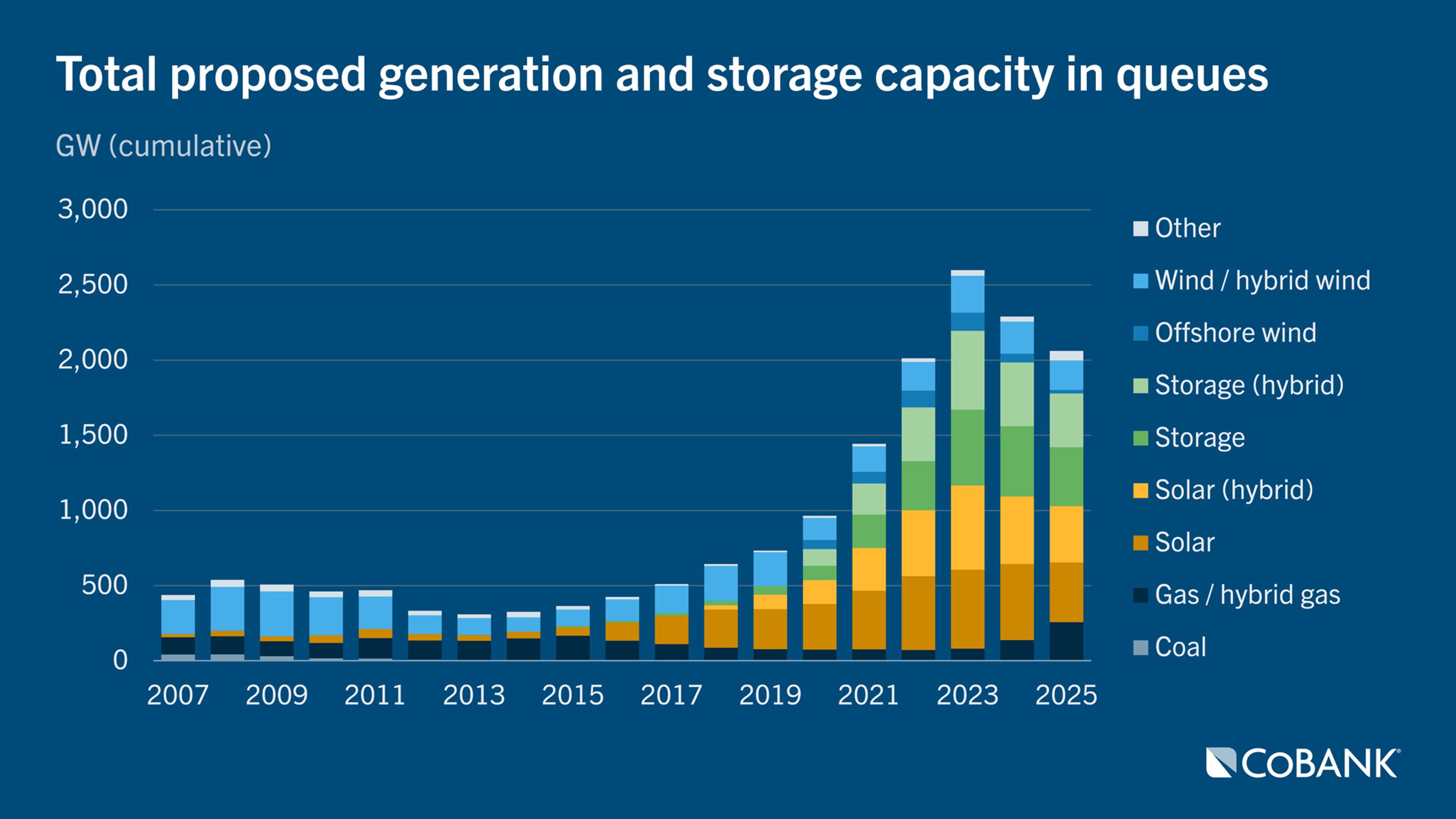
Lawrence Berkeley National Laboratory’s annual Queued Up report identified about 8,200 active U.S. interconnection projects at the end of 2025, totaling 2,061 gigawatts of proposed generation and storage capacity — more than the 1,312 gigawatts installed on the grid today.
The Federal Energy Regulatory Commission is responding to this logjam on two fronts. Its FERC Order 2023 requires transmission providers to move from sequential project reviews toward a first-ready, first-served cluster-study process, supported by stronger readiness requirements, financial commitments and withdrawal penalties. The objective is to reduce backlogs and focus study resources on projects that are more likely to proceed. In June 2026, FERC also opened six Federal Power Act Section 206 show-cause proceedings that require six grid operators to explain how they will speed access for large-load interconnection. Regional grid operators must now justify their existing tariffs or propose changes governing how data centers, manufacturing facilities and other large electricity users connect to the transmission system.
These proceedings mirror the discipline FERC sought to impose through Order 2023 by pushing large loads toward first-ready, first-served access, stronger credit and financial commitments and protections that keep existing customers from subsidizing the costs. Together, the two actions recognize that the interconnection challenge is no longer limited to new power supply. Grid operators must now manage generation projects seeking to enter the system while also responding to large customers seeking substantial new service.
Yet, because FERC’s reforms on both sides of the interconnection are advancing on different timelines, the result could be a piecemeal response that fails to address the broader problem of balancing the grid. The Section 206 proceedings may also face greater legal challenges as they move closer to state authority over retail electric service, economic development and cost allocation. If states believe FERC has overstepped, litigation could delay implementation and leave grid operators caught between federal pressure to accelerate interconnections and state efforts to protect local customers.
Regional approaches to re-engineering the grid
Nevertheless, the rules governing wholesale electricity markets are undergoing a fundamental shift. To accelerate generation deployment beyond FERC Order 2023, regional grid operators are moving away from unconstrained, system-wide modeling and toward more targeted regional or zonal reviews, with growing interest in “connect and manage” energy-only interconnection frameworks. These approaches allow developers to connect under non-firm Energy Resource Interconnection Service, avoiding extensive grid upgrades in exchange for accepting real-time curtailment.
Forthcoming Section 206 show-cause plans also will likely use expedited “operational netting” rather than gross peak impacts, helping large loads bypass multi-year queue backlogs and secure faster access to power. They may also include interruptible or flexible-service provisions similar to energy-only frameworks. The result could be a more adaptable market structure in which grid operators balance new supply and demand through curtailment, storage, flexible load and conditional access rather than relying primarily on firm service and major transmission upgrades.
Faster queues won’t ensure more power
But faster market queues do not necessarily guarantee more power on the grid for the rest of us. PJM’s recent experience shows why. Since 2020, nearly three-quarters of the projects representing 324 GW of capacity that PJM studied eventually withdrew, including 26 GW that had already signed interconnection agreements. In fact, only 23 GWs of capacity are in service today. Higher deposits and steeper withdrawal penalties may screen out weaker projects, but they cannot fix the larger forces that cause developers to walk away, including rising equipment costs, financing challenges, permitting delays, local opposition, supply-chain constraints and uncertainty over whether a project can earn enough revenue to get built.
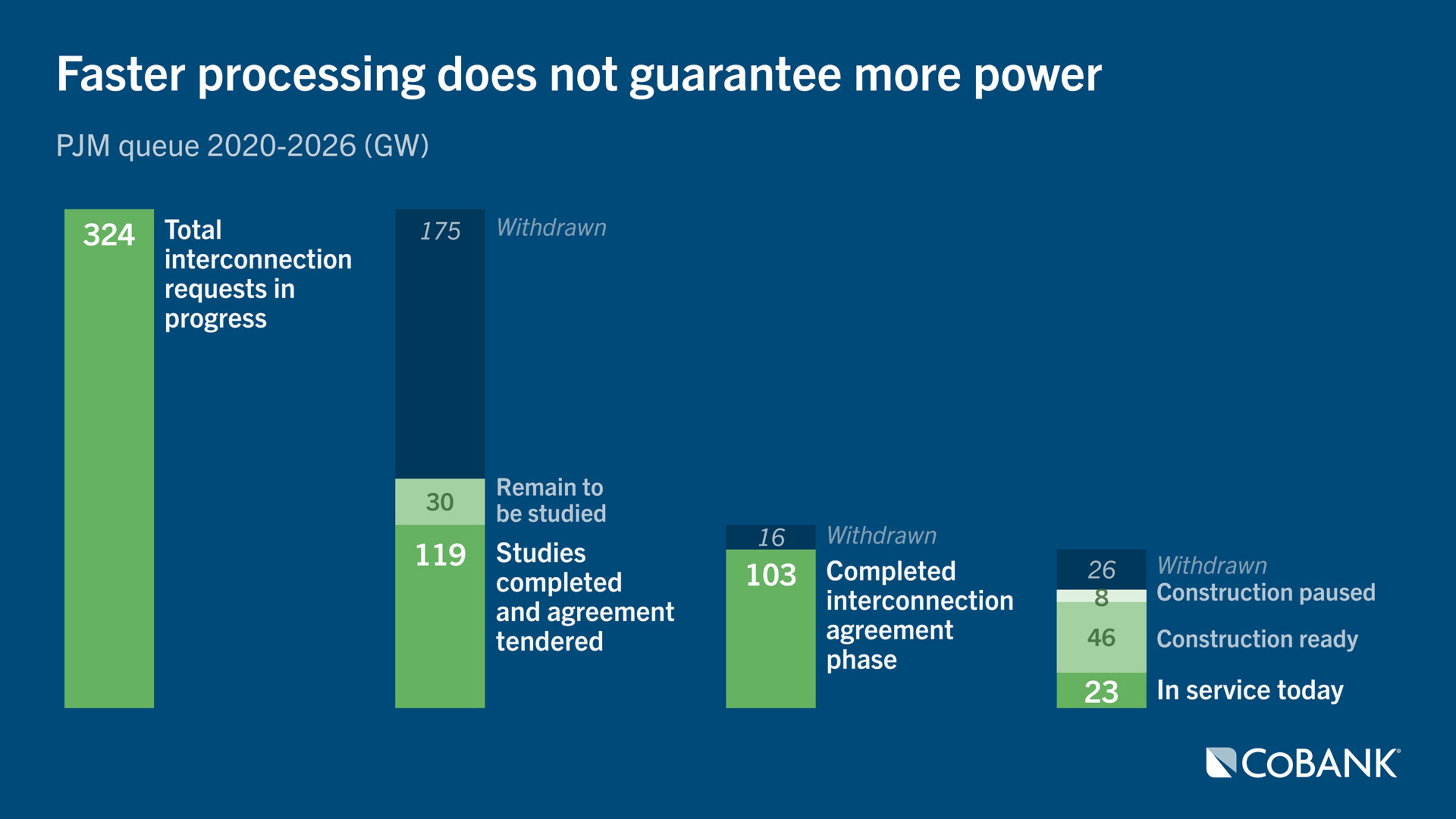
Interconnection reform can improve the process, but it cannot eliminate the other barriers facing power projects. The experience in PJM Interconnection illustrates the gap between queue progress and completed generation. Many projects withdraw even after extensive study, and some withdraw after receiving interconnection agreements.
Interconnection reform is only a first step
The gap between queue progress and completed projects underscores the need to address the barriers beyond interconnection. Closing that gap will require comprehensive permitting reform. The proposed Bipartisan American Affordability and Jobs Act of 2026 would speed environmental reviews, ease multistate transmission siting and limit prolonged litigation after permits are issued if enacted. It would also expand FERC’s role in transmission planning, siting and cost allocation, helping viable projects move from the queue into construction.
Fixing America’s grid logjam requires more than faster interconnection studies. Queue reform must work alongside permitting, transmission development, financing and sound cost allocation to turn viable proposals into operating infrastructure. The measure of success will be a power system that can meet rising demand reliably and affordably without shifting undue costs and risks to existing customers.
Disclaimer: The information provided in this report is not intended to be investment, tax, or legal advice and should not be relied upon by recipients for such purposes. The information contained in this report has been compiled from what CoBank regards as reliable sources. However, CoBank does not make any representation or warranty regarding the content, and disclaims any responsibility for the information, materials, third-party opinions, and data included in this report. In no event will CoBank be liable for any decision made or actions taken by any person or persons relying on the information contained in this report.