
Why higher fertilizer prices are here to stay

Key points
- Unlike the 2022 fertilizer shock, the reasons behind today’s disruption are longer lasting. Geopolitical conflicts and supply chain disruptions will keep fertilizer prices elevated and complicate future sourcing for agricultural retailers and farmers.
- Fertilizer prices, particularly for phosphate products, are projected to rise and remain above pre-Iran war levels through 2028. Ammonia and sulfur are the two biggest variable cost inputs for phosphate production, and 3 of the 10 world’s largest ammonia exporters are behind the Strait of Hormuz.
- Farmers have reduced phosphate and potassium applications by as much as 10%-15% in recent years, a pattern that may modestly support commodity prices and ease inventory concerns for retailers.
Fertilizer prices have come down from their historic highs following the start of the Iran war; however, the ripple effect of the Middle East conflict compounded with tight supplies will create higher prices and sourcing issues in 2027 and beyond. Availability and affordability concerns have created demand destruction and demand deferral that cloud the fertilizer price outlook for the next few years. Market recovery depends on stabilization in the Middle East, sulfur price trends and shifts in global demand patterns.
Unlike the 2022 fertilizer shock, today’s disruption is rooted less in rerouted trade flows and more in damaged production capacity, raw material constraints and uncertain recovery timelines. That makes this a longer-duration risk for U.S. agricultural retailers, who must secure enough supply for farmers without overcommitting to high-priced inventory if demand weakens.
The fertilizer price run-up in 2022 stemming from the Ukraine war forced a reshuffling of the flow of fertilizer products. The current conflict in the Middle East has resulted in shutdowns and damage that will require significant time and resources to restart, long after the war has concluded. An estimated 31 ammonia plants in the Middle East have been directly impacted by the conflict or have shut down production completely. Also, 49 plants in India, Pakistan and Bangladesh are either curtailed or shut down due to constrained feedstock. Lastly, at least 20 plants in Russia have been damaged from Ukrainian drone attacks.
The Middle East plays a critical role in the international fertilizer market, supplying over 60 million tons of fertilizers and raw materials worldwide, with 45 million tons shipped via the Strait of Hormuz. Notably, 50% of globally traded sulfur and over 30% of global urea exports originate from this region, making these commodities particularly vulnerable to supply disruptions.
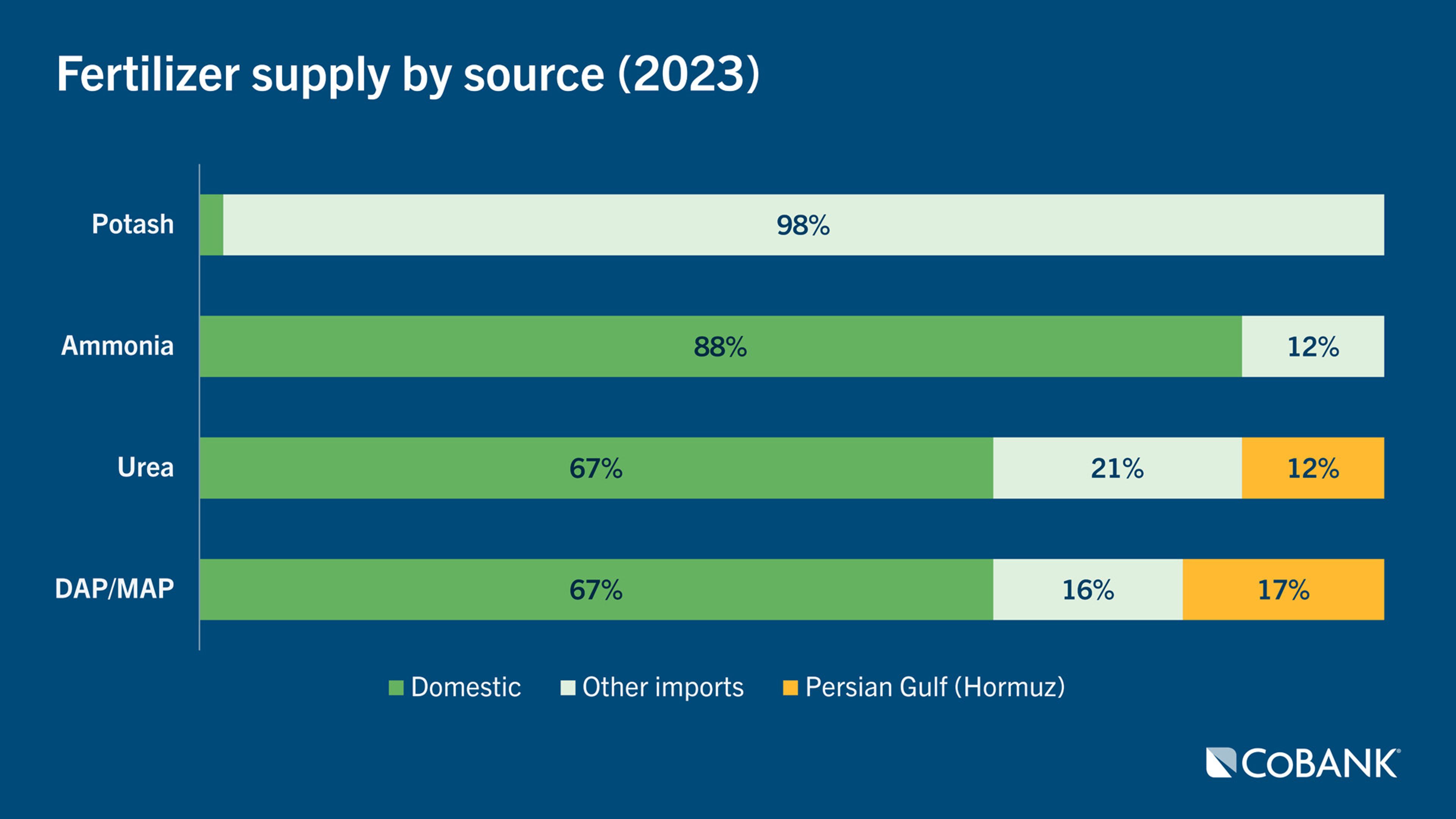
For U.S. agricultural retailers, the Iran war has created the greatest price exposure for diammonium phosphate (DAP) and monoammonium phosphate (MAP) because of growing demand for these imported products from the Persian Gulf. In both urea and DAP/MAP, 67% of domestic use comes from domestic supplies. Meanwhile, 12% of urea and 17% of DAP/MAP products originate in the Persian Gulf region.
Farmers have reduced application rates
Most farmers have already adjusted fertilizer management in response to elevated prices over the past several years. Rather than dramatically reducing application rates, they have relied heavily on soil analysis, variable-rate technologies and better nutrient management to optimize returns. Under-fertilization can be more costly than higher fertilizer prices as it directly reduces crop productivity, in turn increasing the cost of production per unit of output — which is why many U.S. farmers have not pulled back on nitrogen applications.
However, farmers have reduced phosphate and potassium application levels by as much as 10%-15% in recent years. Since 2008, farmers have reduced NPK (nitrogen, phosphorus and potassium) applications by 20%. Lower and no fertilizer use creates a two-to-three-year gap before yield losses appear, raising the question of how much longer growers can mine soil nutrients without sacrificing yield. Cash is tight at the farm gate, limiting some growers from locking in any product for the next crop year until additional financing or working capital becomes available.
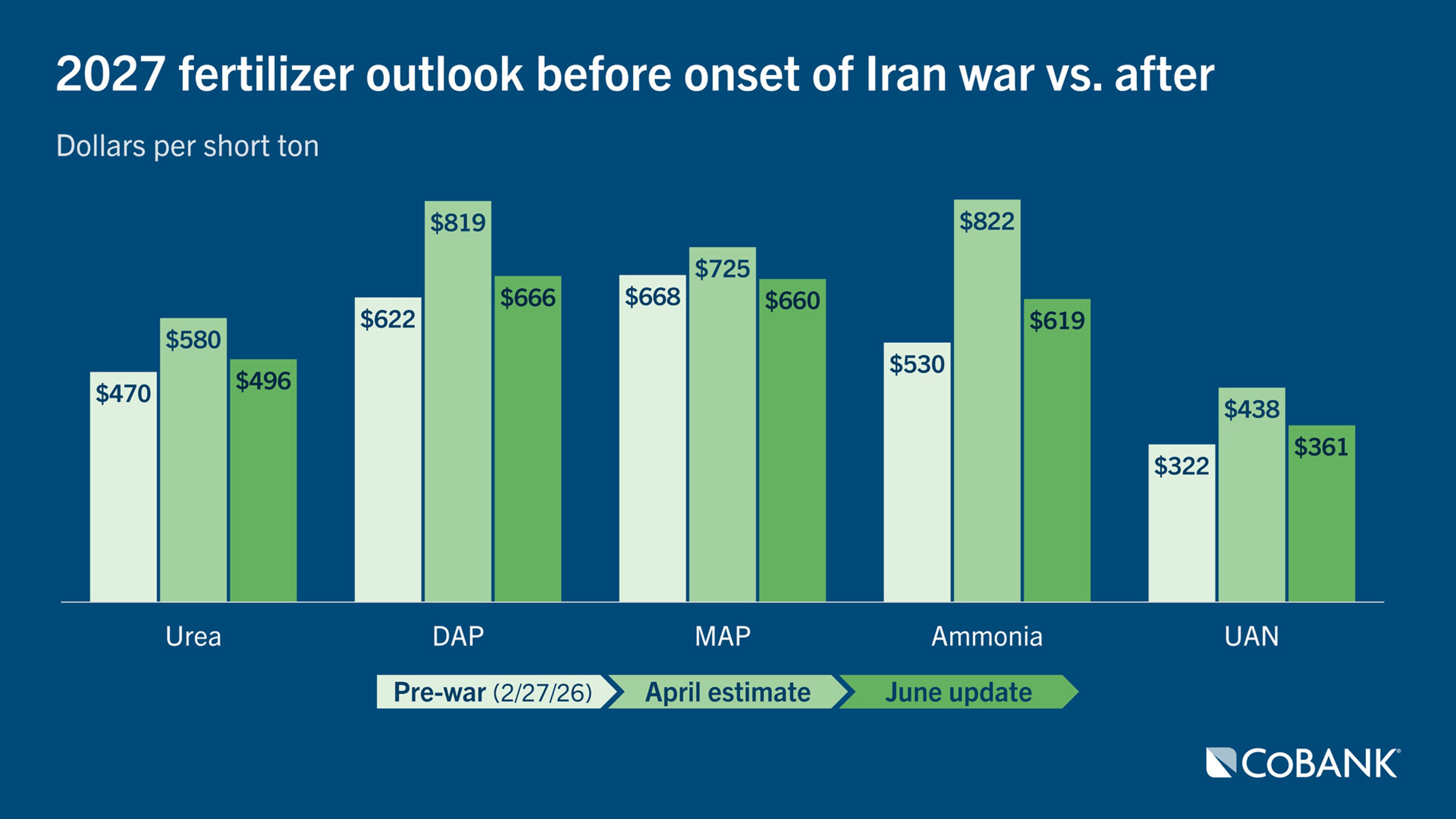
North Dakota State University projected fertilizer prices to continue to rise and then see a prolonged plateau that remains above pre-Iran war levels until 2028. NDSU projects 2027 averages for fertilizer at $496 for urea, $666 for DAP, $660 for MAP, $619 for ammonia, and $361 for UAN. These estimates are lower than NDSU’s estimates in the spring following the conflicts’ greatest surge in prices but still forecast higher prices than pre-war levels.
Nitrogen remains the most important nutrient
Historically, when fertilizer prices are high, farmers prioritize nitrogen application over phosphate and potassium, a pattern evident in 2008, repeated in 2022, and now emerging again. Farmers seem reluctant to reduce nitrogen applications despite rising prices, but affordability will remain a challenge because commodity prices have not rebounded as they did after the 2022 Ukraine war-driven fertilizer price runup.
Agricultural retailers reported summer nitrogen fill was brisk with solid uptake seen at the retail level. Urea ammonium nitrate (UAN) fill came out higher than anticipated and pricing was pulled hours after being published as suppliers sold their position faster than expected. Fill prices typically mark the market low roughly 80% of the time. The question is whether this year falls into the other 20% where the low point may still lie ahead, especially with fall corn futures in the $4 range.
Retailers report the same for anhydrous ammonia (NH3); when fill prices were announced, suppliers took advantage of fill programs at 100% levels. To date, storage capacities are limited compared to the amount of tons typically applied in the fall. Farmers, concerned about affordability, may pull back their purchases. If nutrient prices stay elevated or go higher, and farmers don’t purchase until spring, agricultural retailers face a significant carry cost with interest rates at 6%-8%.
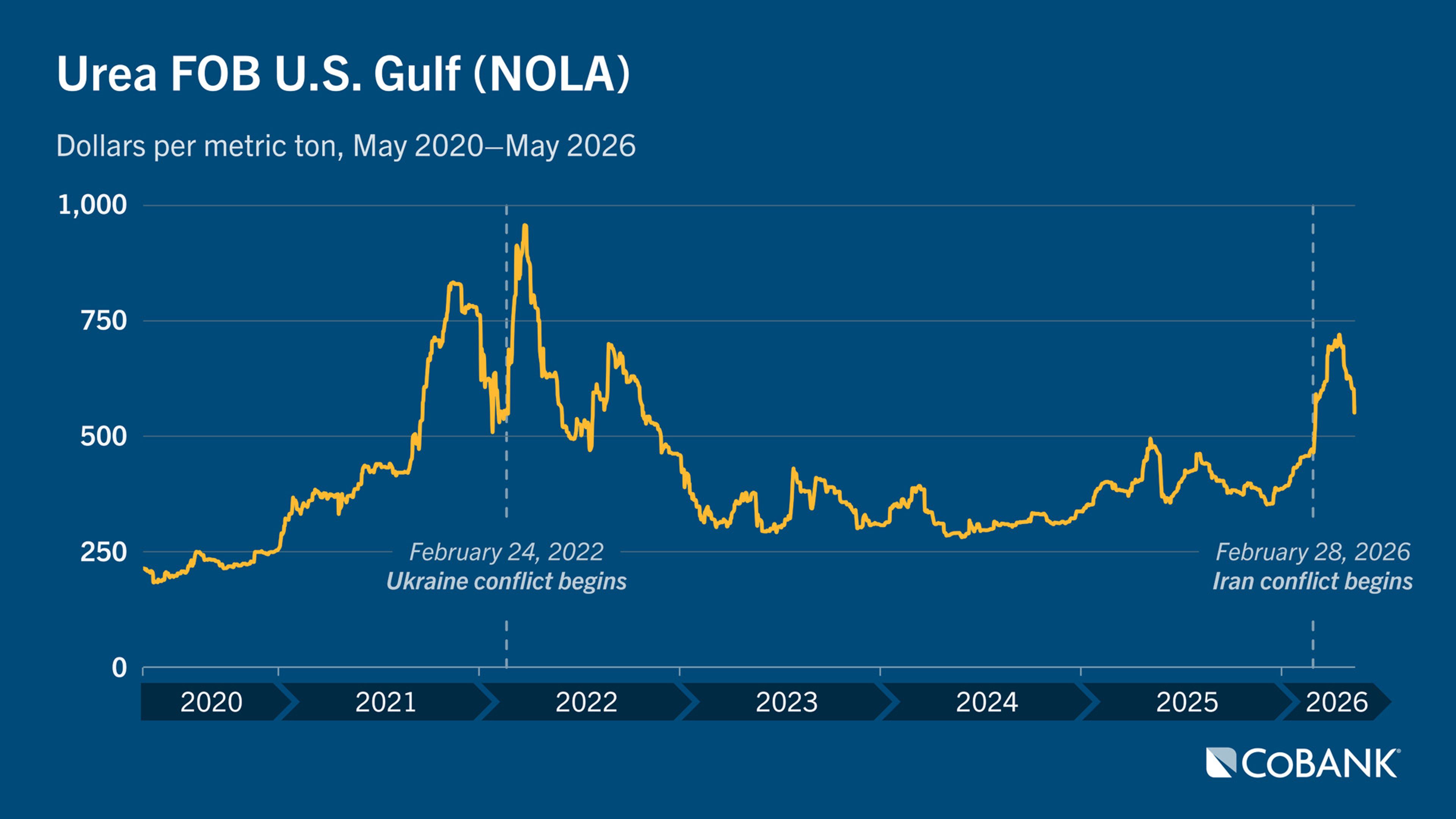
Urea prices were already headed higher ahead of the conflict, and then higher prices sent demand lower. The global urea market shows a close correlation between affordability and import demand, with a 27% decline in demand from April to June, attributed to weakened affordability and market uncertainties. China returned to the urea export market, relieving some pressure on prices. By mid-June, NOLA urea had fallen to $386 per short ton, 18% below its pre-Iran war level, with the demand destruction softening the supply crunch.
Phosphate supplies continue to be tight
Even before the war, global phosphate supplies were limited, and prices were already creeping higher. Ammonia and sulfur are the two biggest variable cost inputs for phosphate production, and three of the 10 world’s largest ammonia exporters are behind the Strait of Hormuz. China, the largest producer and exporter of phosphate fertilizer, has banned phosphate exports through August. High sulfur prices may force China to extend its phosphate ban and further shrink available supplies to the global buyers. Argus projects total phosphate fertilizer consumption (DAP, MAP, TSP) in 2026 to be down by 13%, with production forecasts reduced from nearly 69 million tons to under 60 million tons due to raw material shortages and operational cutbacks worldwide. U.S. is consuming more imported phosphate products in recent years, creating greater exposure to tight world supplies.
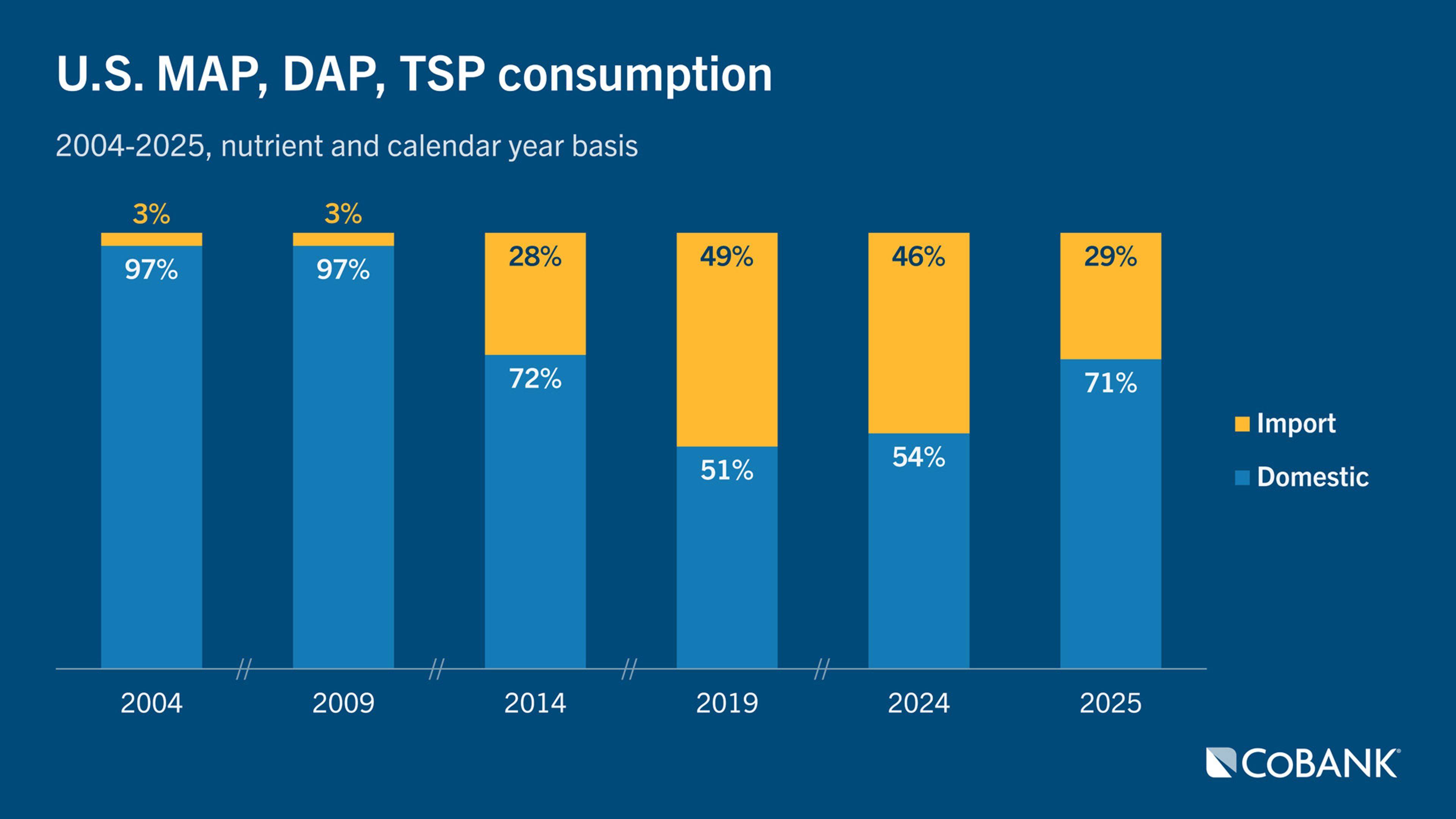
The Iran war has tightened phosphate raw material availability, especially affecting southern hemisphere markets and major consumers like India and Brazil, which together account for 39% of the global consumption decline. China’s phosphate consumption is expected to decline only marginally due to export bans and China’s own government mandates ensuring domestic supply. NSDU assigned a 40% probability that China lifts its phosphate ban in the fourth quarter, allowing 3 million metric tons of Chinese DAP to enter the market.
Mosaic limited U.S. phosphate production due to high sulfur costs but said it could quickly resume production if the market improves. Mosaic’s CEO said during an investor call the company will be forced to pivot to meet the needs of international markets if the U.S. market doesn’t return to purchasing phosphates at historical levels.
Through the summer, retailers reported phosphate pricing holding with price hikes following Mosaic’s announcement to curtail production. The consensus across the retail industry is that phosphate applications will be similar to last year — bleak news for the agricultural retail sector, which has seen phosphate applications decline for the last five years. At the agronomy level, decreased phosphate applications can result in standability issues and increase grain moisture. Corn Belt farmers typically apply phosphate and potassium in the fall, but that timeline could shift. Farmers typically book DAP during dealer fill in the July to September timeframe and apply in October and November. Retailers will need to be ready with supplies but may run the risk of buying too much at high prices that later have to be discounted.
Earlier this summer retailers began looking at initial phosphate positions to be utilized in the fall season and layering in purchases. Farmers have already pulled back on phosphate and potassium purchases in their fertility plans the last several years, and retailers anticipate this cautious mentality to continue. Phosphate applications were reduced in drought-impacted areas in the western and southern Plains. Many retailers may have supplies held over from 2026 to meet partial 2027 demands, which is expected to stay low.
In June, President Trump issued an executive order suspending countervailing duties on Moroccan phosphate fertilizer imports. The suspension will last for eight months, “or until the emergency is terminated,” according to a White House fact sheet. The action was welcomed by agricultural groups who believe this provides much-needed relief to farmers who continue to face tight margins and high input costs. NOLA DAP is consistently the cheapest major price point across the globe; therefore, lifting the phosphate duties may not create more imports from Morocco as world supplies remain tight.
The risk for retailers
If prices remain elevated through the fall, farmers could have a greater incentive to push applications to the spring. This reality would create an even more treacherous trail for agricultural retailers to manage fertilizer applications and get supplies where they are needed ahead of any short planting windows.
Fertilizer companies stated on recent investor calls that although commodity prices have not risen alongside fertilizer prices as they did in 2022, lower application rates globally could modestly reduce yields and provide some support for commodity prices. This may provide more normal farmer purchasing and ease some worry that retailers may be stuck holding large inventories without willing buyers at high prices.
As a whole, fertilizer markets are unlikely to return quickly to pre-Iran war conditions. Nitrogen and phosphate supplies remain exposed to production outages, raw material constraints and uncertain trade flows, while potash is comparatively insulated except for higher shipping costs. For agricultural retailers, the central challenge will be balancing supply security against inventory risk: they must have product available for narrow application windows without overcommitting to high-priced tons if farmers delay or reduce purchases. For farmers, elevated prices will keep nutrient decisions under pressure and could extend the recent pullback in phosphate and potassium applications. Even if prices stay below the extreme levels feared after the Strait of Hormuz closure, the industry should prepare for fertilizer costs to remain structurally higher — and more difficult to manage — through the next several crop years.
Disclaimer: The information provided in this report is not intended to be investment, tax, or legal advice and should not be relied upon by recipients for such purposes. The information contained in this report has been compiled from what CoBank regards as reliable sources. However, CoBank does not make any representation or warranty regarding the content, and disclaims any responsibility for the information, materials, third-party opinions, and data included in this report. In no event will CoBank be liable for any decision made or actions taken by any person or persons relying on the information contained in this report.