
Higher prices will ripple through entire farm supply chain

Key points
- Soaring fuel prices are driving up harvest, drying and hauling expenses for farmers and grain customers.
- Fuel surcharges may be an option for ag retailers to provide transparency on higher diesel costs.
- Farmers will face important decisions for the 2027 crop year this fall as fertilizer prices remain elevated.
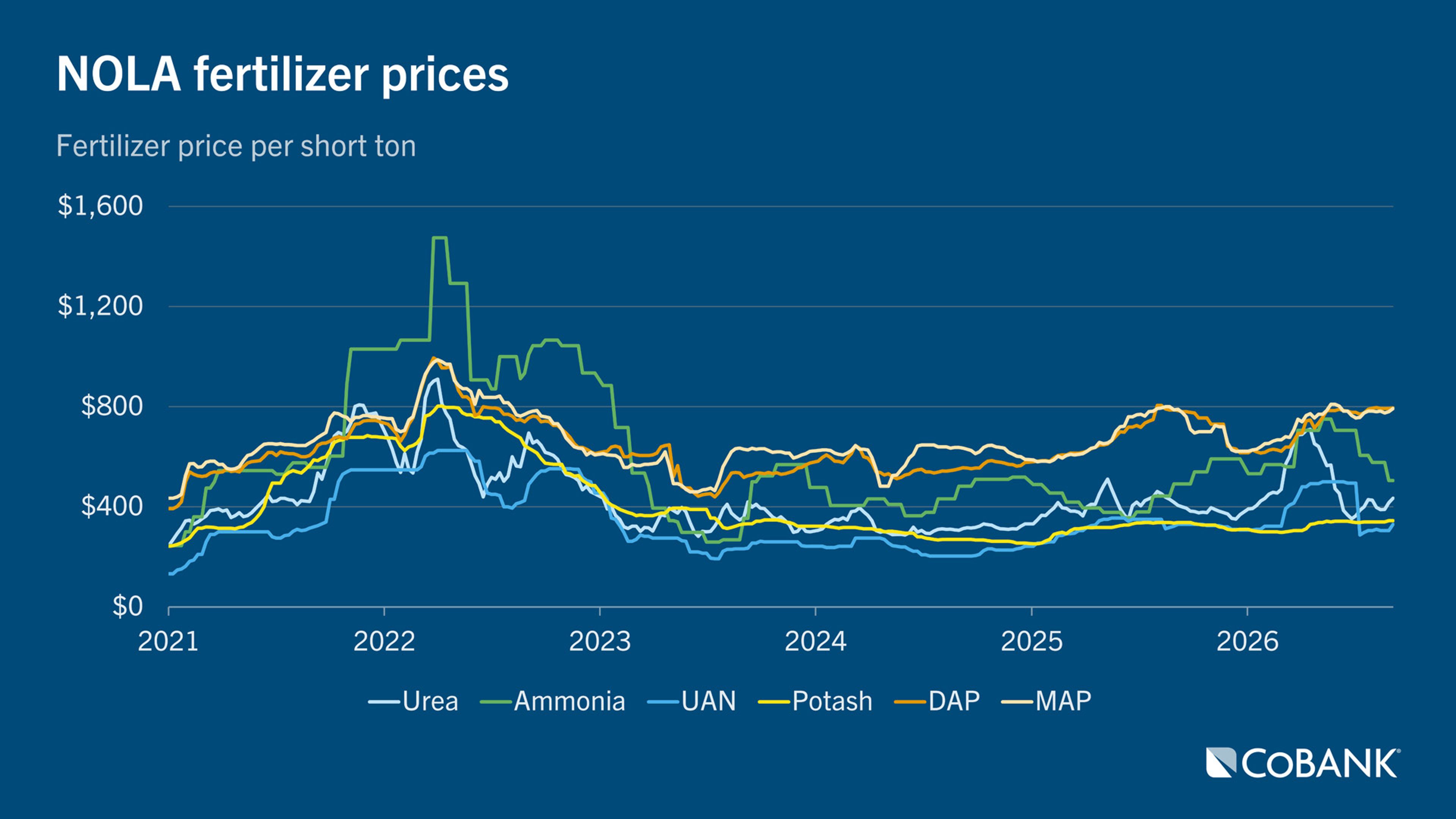
Heading into fall, diesel prices are nearly 80% higher than they were last year, creating additional expenses that will be difficult to absorb from the farm gate through the entire supply chain. Adding insult to injury, earlier this year analysts anticipated that interest rates would edge down. However, the Federal Reserve’s September rate increase indicates that’s unlikely in the near term as higher energy costs fuel higher inflation. Although Corn Belt fertilizer prices have not reached their 2022 peak, current farm economics still make fertilizer purchases economically challenging.
Diesel fuel is a significant expense for trucking grain and other agronomy and energy goods. The nationwide average retail price for on-highway diesel reached $6.38 per gallon for the week ending Sept. 28, up from $2.62 the year before, according to data from the USDA’s Agricultural Marketing Service. Rail fuel surcharges are also on the rise, with October 2026 rates at $0.59 per mile, up 40 cents from the October 2025 rate and nearly three times the three-year average of $0.23 per mile, AMS stated.
For agricultural retailers and farm supply providers, fuel surcharges may be one way to be transparent to customers and help detail higher delivery costs. Some companies pass fuel costs directly to patrons, while others adjust margins through coordination between operations and sales.
Higher input costs are not offset at the farm level
Commodity prices for corn and soybeans pushed higher in August, but those gains have not been enough to offset the concurrent run-up in input prices, notably fertilizer and fuel.
At the farm level, USDA projects fertilizer expenses for 2026 at a record $40 billion, up 15%, or $5 billion, from the previous year. Similarly, fuel expenses, including diesel, are projected to reach a record $22 billion this year, up 29%, or $5 billion, from 2025, according to a Market Intel report from the American Farm Bureau Federation. The average farm diesel price reached $5.75 per gallon on Oct. 2, up from $3.02 a year earlier.
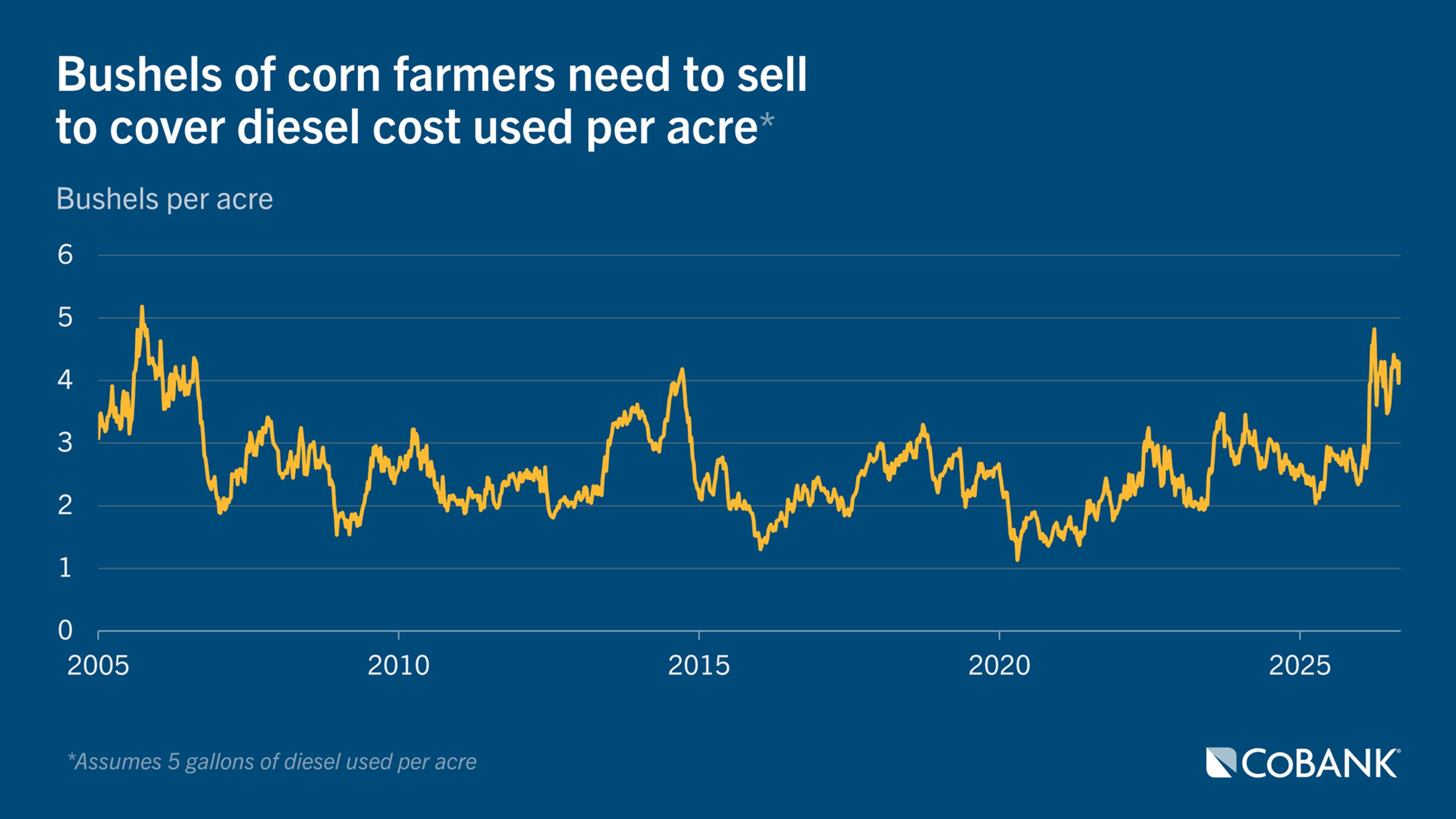
Iowa State University estimates that producing 1 acre of non-irrigated corn requires 4–6 gallons of diesel. Using 5 gallons per acre and current spot futures prices for corn and ultra-low-sulfur diesel, CoBank estimates a farmer must sell roughly 5 bushels of corn to cover that fuel cost, up from 3 bushels last year.
These higher costs will become more pronounced during harvest, when farmers rely on diesel to operate combines and tractors pulling grain carts, as well as trucks hauling grain.
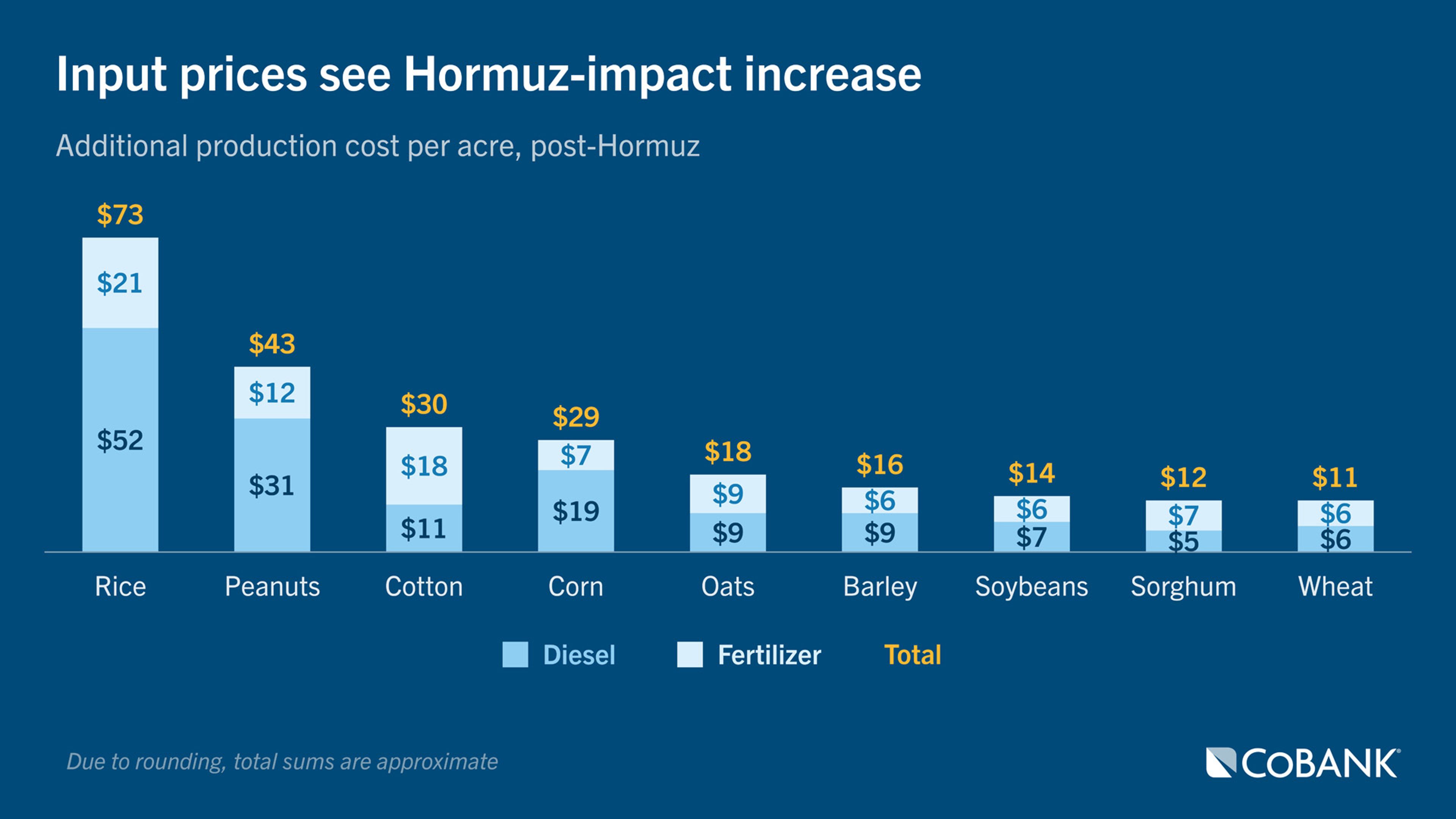
AFBF estimates that corn producers will pay an additional $19 per acre for diesel and $7 per acre for fertilizer as a result of the Hormuz closures. Meanwhile, rice producers will face the largest increase: an additional $52 per acre for diesel and $21 for fertilizer, for a total of $73 per acre.
Fertilizer supplies remain adequate, but prices stay high
Agricultural retailers expect agronomy and fertilizer prices to remain elevated this fall, but they do not anticipate product shortages. Customers have built inventories conservatively but appear to have sufficient product. Drought and lack of rainfall, rather than price, have limited agronomy activity in the central Plains.
Fertilizer prices have eased in some categories and remain below the levels anticipated shortly after the Iran war began, although prices for several products have risen in recent months. Farmers have been slow to commit, but agricultural retailers saw some buyers return when commodity prices strengthened in August. McKinsey reports that fertilizer is often the first major input farmers cut when margins are tight — and the first they restore as profitability recovers. Nearly half of the farmers surveyed said they would prioritize reinvestment in fertilizer as profits improve.
Multi-year reductions in fertilizer applications may also reduce yields in this year’s crop. If commodity prices have bottomed out and are turning the corner to higher break evens, agricultural retailers may see additional farmer demand. Retailers must balance potentially stronger demand against the risk of overbuying high-priced fertilizer. Meanwhile, a delayed harvest due to wet conditions may also limit farmers’ fall fertilizer purchases and push applications into the spring.
Disclaimer: The information provided in this report is not intended to be investment, tax, or legal advice and should not be relied upon by recipients for such purposes. The information contained in this report has been compiled from what CoBank regards as reliable sources. However, CoBank does not make any representation or warranty regarding the content, and disclaims any responsibility for the information, materials, third-party opinions, and data included in this report. In no event will CoBank be liable for any decision made or actions taken by any person or persons relying on the information contained in this report.