
Defining co-op data center service obligations

Key points
- Retail choice amplifies the inherent challenges of serving large loads by introducing competitive dynamics, procurement uncertainty and additional cost recovery risks.
- REC worked with its state regulator to level the playing field — enabling cooperatives in Virginia to create subsidiaries that can make unregulated sales of power to large-load members to shield its membership.
- Combined with novel large load rate design, REC ensures infrastructure and energy access in an equitable and cost-causative manner.
To help illustrate how electric cooperatives are navigating fast-moving, complex large-load requests, we sat down with a group of executives from Virginia’s Rappahannock Electric Cooperative (REC), including Dr. John Hewa, CEO; Brian Doherty, managing director of regulatory affairs; and Kayla Coleman, economic development manager.
Data centers constitute over 80% of outside investment pouring into the state of Virginia and many of the counties served by REC view this development as an economic opportunity for their communities. While most of the construction has taken place in northern Virginia, new data center expansion is shifting into central Virginia, expanding opportunities for REC. This co-op, with a traditional peak of 1,150 megawatts serving 183,000 accounts, is now entertaining roughly 20,000 megawatts of inbound data center requests. According to John Hewa, about 20% of this capacity is already under contract and either in construction or deep in the procurement process, representing over $800 million in commitments.
Yet, even if these communities opposed data center development, the co-op still has a legal duty. As John explains, "under the Virginia Code, we have an obligation to serve." REC interprets its obligation as inclusive of all customers—from small residential dwellings to large gigawatt data centers—ensuring infrastructure and energy access in an equitable and cost-causative manner. His specific reference to access to supply is important here, as it is the sole element of the electricity delivery chain that REC has direct control over. REC provides electricity delivery to its members and then facilitates energy access to upstream transmission and generation through others – in the case of transmission, it would primarily fall to Dominion, and its generation and transmission (G&T) cooperative, Old Dominion Electric Cooperative (ODEC) for generation.
While we can’t directly control power supply costs, we work hard to control the parts we can…
What about the other upstream supply elements such as generation and transmission, the services provided by other organizations that could expose the co-op to financial risks? Over the past two years, REC staff and board members have worked diligently to define their legal obligations, the costs involved in providing new service to large hyperscalers and practical approaches to mitigate risks for their existing membership. Because Virginia allows large commercial or industrial customers to choose their electricity supplier, does this mean that the local distribution company’s obligation only extends to providing delivery or the services under their control?
REC worked methodically with its state regulator to properly define its service obligations under the state’s retail choice framework. This ultimately led to the amendment of Virginia’s state code as of July 1, 2025, allowing cooperatives to create subsidiaries that can make unregulated sales of power to large-load members with load of 90 MWs or greater to meet their service obligations. This modification introduces a significant policy shift in the state, allowing the obligation to serve hyperscale data centers to be borne by cooperative affiliates rather than the cooperatives themselves.
Rate design – isolating, aligning and assigning risk along the supply chain
How exactly will this arrangement satisfy REC power supply requirements for data centers fairly while protecting existing members? Or, as John succinctly puts it, ensure infrastructure and energy access in an equitable and cost-causative manner.
As mentioned, REC gets all its electricity from ODEC through its existing G&T Wholesale Power Contract (WPC). Data center developers have proposed constructing facilities whose electric power demand would exceed both the aggregate peak demand of REC's entire service territory as well as ODEC’s total aggregate membership served by these contracts. In 2024, ODEC's board of directors passed a series of affirmative resolutions declining offers to supply a total of 13 potential exceptionally sized customers in REC's service territory, requiring REC to fulfill its upstream supply obligations through the PJM wholesale power market.
The challenge REC faced was having to stand up operations to secure the necessary wholesale power for these new customers without saddling existing members with (1) the costs of funding those operations or (2) the associated credit risk in the event of non-payment for that supply. Their solution was to establish a subsidiary, Hyperscale Energy Services LLC (HES), that in turn would form another layer of drop-down subsidiaries (called Dedicated Service Affiliates or DSAs) for the purpose of procuring power supply to these exceptionally-sized customers, while shielding the parent co-op and its membership from the debt and liabilities associated with those activities. Conceptually, every new data center owner would have their own separate DSA established under REC’s new supply subsidiary HES. And based on the change in state law, the financial risk associated with upstream supply procurement would shift to that drop-down subsidiary.
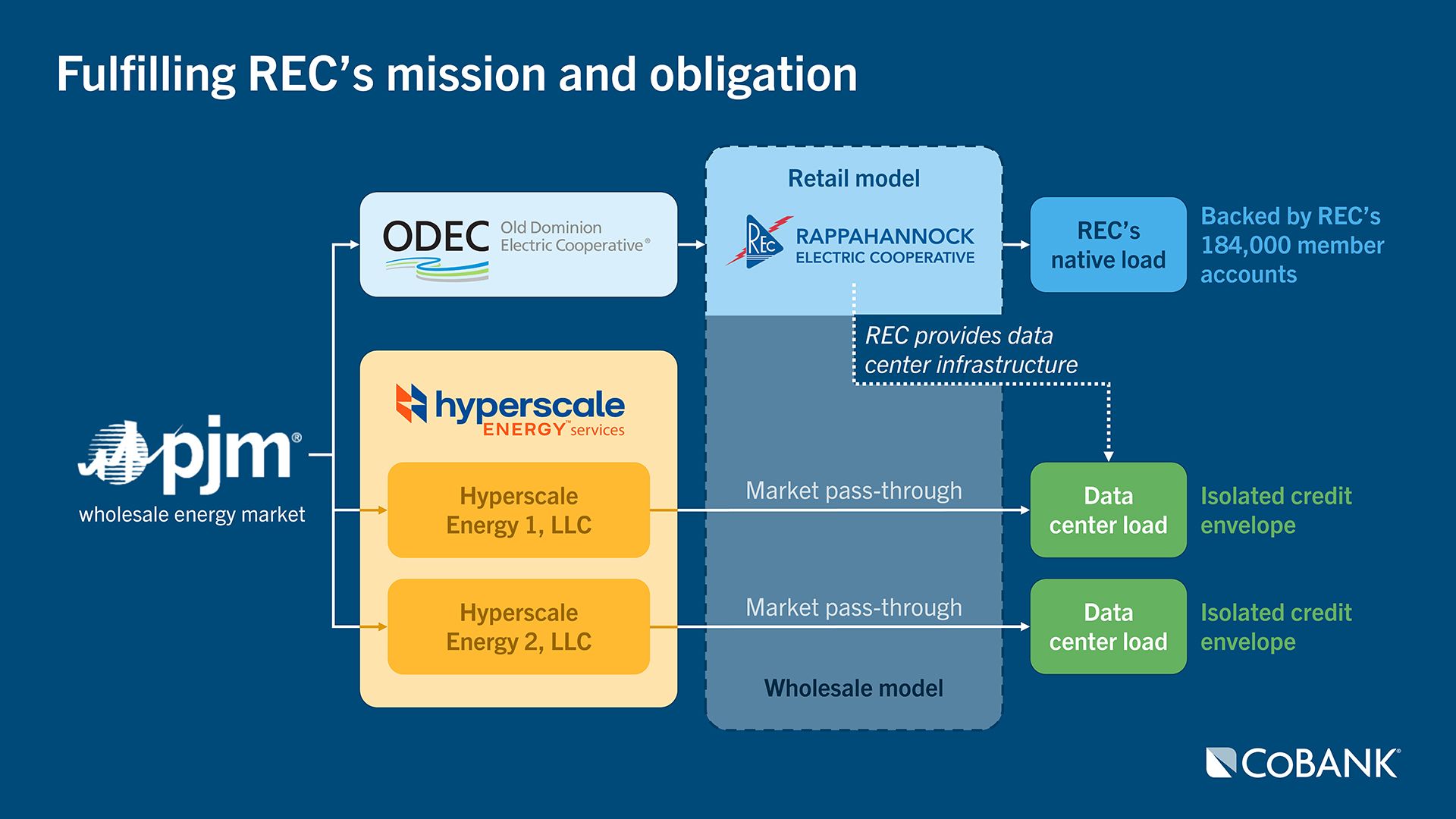
How exactly will this arrangement work? REC will supply its existing members under the ODEC’s WPC agreement but enable new data center members and other large loads to procure unregulated purchases of PJM power under a separate DSA WPC (as now allowed under Virginia’s revised state code). By structuring power procurement separately from REC’s ODEC-supplied generation, the wholesale energy costs for these large load customers are not co-mingled.
The “cost-causative” principle that John talks about is a fundamental and widely accepted tenet of utility ratemaking – it states that the customers who cause a utility to incur costs should be the ones who bear those expenses. Through the affiliate arms-length relationship, REC can properly adhere to this principle. That is, account for not only the supply purchases from each data center but also the costs associated with administering those purchases – especially since managing PJM supplied generation, on behalf of these new members, will prove more time-intensive than the ongoing coordination of ODEC supplies for existing members.
Rappahannock interprets the duty to serve as inclusive of all customers — from small residential dwellings to large gigawatt data centers — ensuring infrastructure and energy access in an equitable and cost-causative manner.
In testimony provided to Virginia’s regulator on a new proposed rate structure, Brian Doherty emphasized the importance of separating power procurement from delivery costs to align with REC’s business and financial exposure. These novel affiliate wholesale supply agreements directly pass through supply costs and insulate existing REC members from cost-shifting. Through their recently approved Large Power-Dedicated Facilities Rate (LP-DF) REC can structure the second element of the data center bill – the co-op’s controlled downstream delivery costs – in the same equitable and cost-causative manner.
The LP-DF rate captures the balance of costs that REC incurs for providing service and compensates the co-op for the economic value of the existing system, through: 1) a Service Charge (related to the costs REC incurs for managing the PJM generation purchases), 2) a Delivery Service Charge (related to REC’s downstream distribution costs), and 3) an Excess Facilities Charge (a catch-all category for recouping excess costs not covered by the delivery service charge, for situations where member system use exceeds stated parameters). The novelty of the LP-DF rate design is that both the Service Charge and Delivery Service Charge are structured exclusively as demand charges on a per megavolt-amperes (MVA) basis.
As Brian explains, these (data center) facilities operate with high, stable, and predictable demand, making a demand-based rate structure more reflective of system costs. A per-MVA structure ensures that cost recovery is directly tied to the actual capacity needs of these customers – a typical rate based upon volumetric demand (kW) and energy usage (kWh) would not accurately reflect the infrastructure investments required to serve them.
Data centers operate with high, stable, and predictable demand, making a demand-based rate structure more reflective of system costs.
Brian compares REC’s distribution infrastructure investment for data centers to constructing a water pipeline that will ultimately be used by a single water consumer. In his scenario, the upstream water supply is charged separately from the pipe. Thus, collecting the construction costs of building that pipeline upfront from this water customer and then structuring ongoing payments based on the fixed costs of maintaining and replacing that pipe ultimately better aligns with the actual investment the water company makes. In contrast, the alternative method relies on billing based on metered water usage, which offers less precision for recovering capital infrastructure investments and operation and maintenance expenses. Consequently, this new rate design offers a better fit, and its fixed structure makes revenue predictability easier for the co-op and cost management simpler for members. Lastly, requiring the data center to pay for their dedicated system upfront ensures more efficient use of capital, avoiding stranded assets and saddling the co-op and its membership with stranded costs.
As for rate design, putting aside the smaller ‘service charge’ that reflects the co-op’s expenses for managing the PJM supply purchases, the larger component of the data center’s bill under REC’s rate schedule reflects the ‘Delivery Service Charge.’ Practically speaking, new customers that are 25 MWs or greater and operate at a load factor of at least 75% will be served on the REC distribution system through dedicated substation facilities at a delivery voltage of 34.5 kV (or greater where applicable). The Delivery Service Charge then incorporates the direct costs of designing, permitting, constructing and installing these dedicated facilities, as well as operations and maintenance expenses and property taxes associated with them. It also includes indirect costs and a contribution margin to compensate the co-op for the use of the existing system.
The way that this functionally works is that new large load members will initially fund the co-op’s investment in the dedicated facilities through an upfront contribution-in-aid-of-construction (CIAC) payment. The recurring Delivery Service Charge will then recoup the rest of the expenses (O&M expenses, property taxes, indirect expenses, and a contribution margin) for the agreed upon level of load. The Excess Facilities Charge will function as a form of Delivery Service Charge true-up; to recoup any costs associated with additional facilities required above that threshold, with the customer once again making an upfront CIAC payment with a continuing Excess Facilities Charge for the rest of the expenses.
As Brian summarizes, “infrastructure, service and access to the market are most important for these types of customers…So that's how we need to price it, right? Rather than actual usage and demand, (hyperscalers) are going to pay a rate commensurate with the amount of distribution capacity dedicated to their service, and it's not measured in terms of megawatts, but MVA on the nameplate of the transformers that comprise the substation dedicated for their use.”
Member onboarding process – clarity, responsibility and readiness
The REC executives we spoke to emphasized building strong relationships with data center customers and local communities, recognizing the economic development benefits while balancing the risks of rapid load growth. Their approach includes transparent processes, standardized documentation and active partnership to facilitate project success. But what exactly does the process look like from the customer’s perspective?
The large load member onboarding process outlined by Kayla Coleman begins with a conversation, educating the prospective member about what it means to be part of an electric co-op and REC’s interconnection process. That exchange will take place with a staff member from REC's dedicated Growth Division – a single point of contact within the co-op, managing economic development and project management for these large loads – and will ultimately result in a signed Letter of Intent (LOI), should the prospective member decide to move forward. While non-binding, the LOI identifies the potential scope of work, the roles and responsibilities for REC and the new member and provides initial clarity of the terms that will anchor future binding agreements.
Establish a single point of contact within the organization to manage the relationship, guiding the new member through the initial intake through to facility energization and beyond.
From here, the prospective member will fill out a standard Letter of Authorization (LOA) form. This fillable PDF gathers all the necessary information, such as site location (GPS coordinates, Google map images, etc.) and power requirements, for the initial feasibility and transmission studies that REC conducts in coordination with transmission operators. The scalable application fee covered in the LOA will be based on the size of the project, covering the costs REC incurs to the transmission operator for conducting the upstream transmission studies as well as their own distribution system planning costs. The executed LOA, evidence of site control and payment of the fee will initiate the feasibility study process to evaluate the technical, economic, and regulatory viability of the project.
Once viability is confirmed, the scope of the project delineated and the costs of service established, REC and its member are ready to enter into a Construction Development Agreement (CDA) to initiate material procurement and construction. This CDA is executed simultaneously and mirrors REC’s Engineering, Procurement, and Construction (EPC) contract to ensure alignment of terms and payments.
It is at this point that those substantial upfront capital contributions (CAIC) come into play. Approximately 60% of the projected substation price tag will be due within about 10 business days of CDA execution with the remainder of the project’s pass-through costs paid in two separate milestone tranches and a final true-up payment due at project completion. As outlined in the LOA, REC will own and operate all utility-scale infrastructure prepaid by the data center and will secure remaining project exposure through irrevocable letters of credit and other financial assurances.
From an operational standpoint all construction takes place directly off the transmission infrastructure with none of the large load member’s equipment intermixed with REC’s normal distribution infrastructure. These are high-voltage 230 kV electrical lines carrying enormous amounts of electricity (300 MW delivery points) with two primary nameplate transformers of 149 MVA's sitting side by side and two more 149 MVA's sitting next to each other offering redundancy.
After a customer's facility has been energized and the initial contracts (LOA and CDA) have fulfilled their purpose, it is essential to have delivery (the Electric Service Agreement, ESA) and power supply service (the Power Supply Agreement, PSA) agreements already in place. Members will need to execute both agreements at least 12 months prior to planned facility energization to ensure contractual continuity.
In addition to referencing the specific upfront capital requirements for the customer, the confidential ESA will provide specifics around monthly billing charges. The approved LP-DF Rate Schedule reflects a generic Service Charge varying from $529.19 per MVA for a single customer associated with a substation upwards to $3,175.14 for six customers. While the LP-DF referenced Delivery Service Charge establishes a $874.04 per installed MVA per month rate.
REC will execute a specific WPC, between REC and the DSA following execution of a PSA between the REC and each individual customer. Once a customer satisfies the requirements of Virginia’s retail choice requirements (56-577 A), they may alternatively elect to receive power supply from a competitive service provider.
Standing up for members at every level
REC’s comprehensive framework for serving large data centers in Virginia exemplifies a proactive, balanced approach to infrastructure investment, financial risk management, regulatory compliance, and customer service. By innovating in rate design, contractual protection, and energy supply models, REC aims to support significant economic growth while safeguarding its broad membership and ensuring reliable service in a rapidly evolving energy landscape.
Disclaimer: The information provided in this report is not intended to be investment, tax, or legal advice and should not be relied upon by recipients for such purposes. The information contained in this report has been compiled from what CoBank regards as reliable sources. However, CoBank does not make any representation or warranty regarding the content, and disclaims any responsibility for the information, materials, third-party opinions, and data included in this report. In no event will CoBank be liable for any decision made or actions taken by any person or persons relying on the information contained in this report.