


This digital guide is a practical resource to help electric cooperatives address the unique challenges of integrating large loads. Based on candid interviews, market research and analysis, this guide shows how cooperatives are earning new business and delivering value to their communities—while adopting robust contract structures to protect members from bearing the costs of serving large loads.
knowledge exchange
A G&T coordinated approach to upstream cost allocation
Key points
- Tri-State’s High Impact Load Tariff filing with FERC highlights the regulatory challenges for developing a coordinated G&T and Distribution Utility Member approach to large-load cost allocation.
- Nevertheless, the straightforward tariff language contains transparent interconnection criteria, upfront payments, equitable contract terms and unique flexibility for demand/energy charges — offering valuable guidance for co-ops developing large-load rates.
- The bottom line is that effective large load supply management will require a high level of coordination between retail and wholesale players to ensure that service risks are not simply transferred upstream on the grid.
Tri-State Generation and Transmission Association, Inc.’s (Tri-State or G&T) core obligation is to provide its member systems—a network of 40 electric distribution cooperatives and public power districts across Colorado, Nebraska, New Mexico, and Wyoming—with a reliable, affordable, and responsible supply of electricity. The increase in large, high-impact load requests has created the need for new operational and financial approaches to fulfill this mission, with regulatory coordination creating some delays in implementing a more unified approach for energizing data centers and other significant local economic drivers.
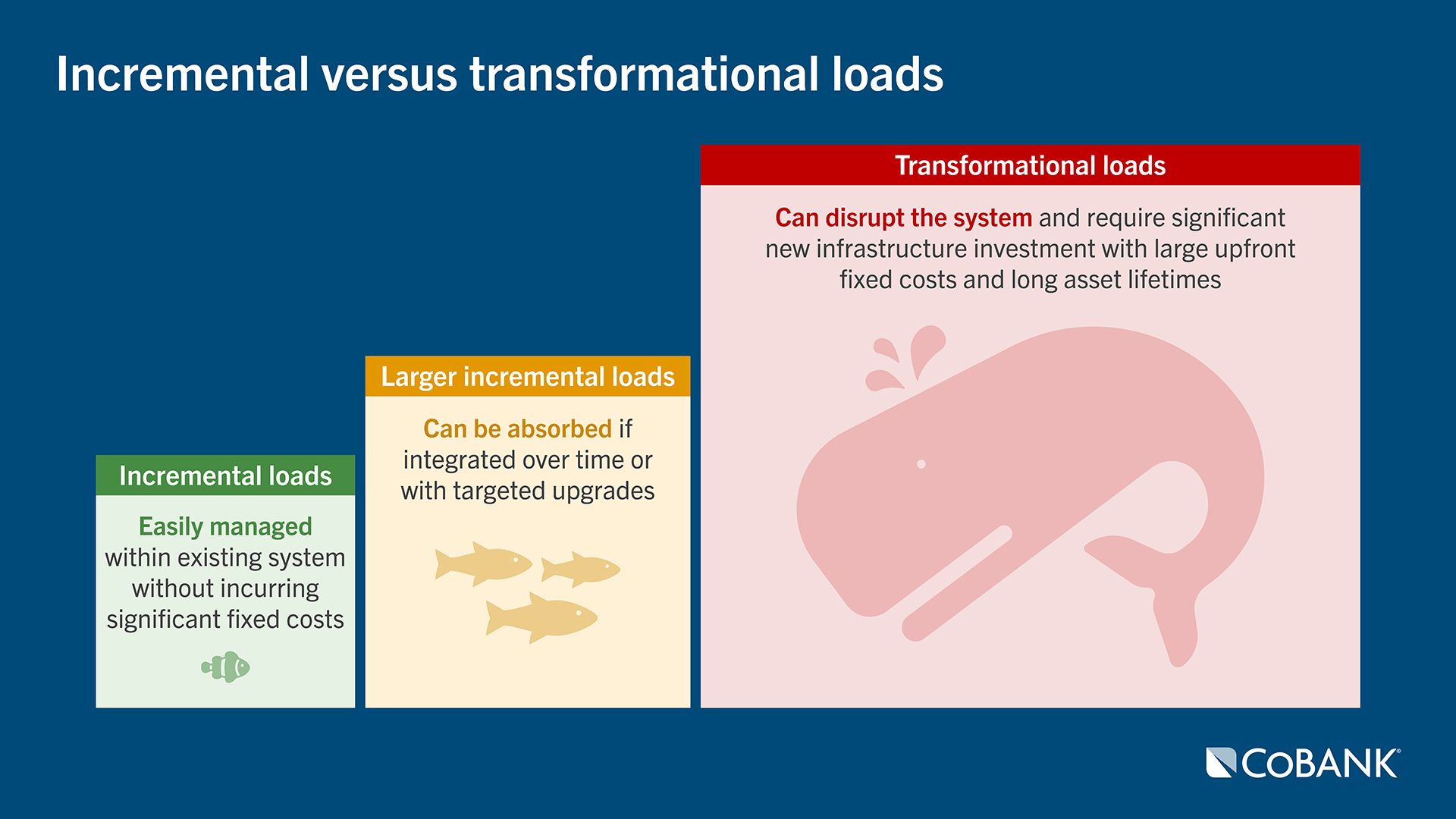
Traditionally, load modifications on the Tri-State system have been incremental (e.g., ranging from 5 to 20 MWs with an historical mean of 7 MWs), but in 2024, Tri-State began receiving requests for massive, rapid load increases—sometimes hundreds of megawatts, or even a gigawatt within a few years. By August 2025, the G&T had already received 10 data center requests from Utility Members for single site interconnections ranging from 45 to 650 MW at commissioning and then increasing to 300–1,000 MW over the next decade, with tight in-service dates between 2026 and 2029. Since inception in the early 1950s, Tri-State has operated with surplus capacity, enabling it to manage additional load requests smoothly. However, recent service requests — collectively totaling more than 5 GW with some likely to be only speculative applications — create a new dynamic for Tri-State’s 2.5 GW peaking system. Managing these new load interconnection requests along with the anticipated related resource requests comes at a time of transmission interconnection queue backlogs, supply chain delays and higher reserve margins being required due to an evolving resource mix on the grid as well as increasing severity of extreme weather events.
We sat down with Lisa Tiffin, the G&T’s chief commercial officer, to better understand how Tri-State is working through these challenges with its membership and collectively defining what CEO Duane Highley calls, “a path forward for serving large loads that is fair and repeatable.” Among her various duties, Lisa oversees Tri-State’s long-term resource planning, load forecasting and resource acquisition. At the time of our conversation in early September, Tri-State had just filed its High Impact Load Tariff (HILT) with the Federal Energy Regulatory Commission. HILT would provide an integrated process to add large loads to the Tri-State system, ensuring related grid (generation and transmission) and distribution costs are not unfairly passed on to other members. The originality of this tariff lies in the fact that both upstream and downstream supply components (the “G, T & D”, if you will) are addressed in a single filing, enabling an integrated approach to cost allocation.
In her FERC testimony Lisa emphasized that, “the novelty and challenge of planning for high impact load growth in an era of evolving economic, policy, and market conditions results in the need to develop a new approach to be responsive to load requests over a certain MW threshold in a manner that appropriately mitigates Utility Member impacts and respects regulatory requirements.” What Lisa is alluding to, with her “meets regulatory requirements” comment, is that Tri-State's new FERC tariff must comply with the Federal Power Act, which separates FERC's oversight of wholesale sales from state regulation of retail rates as well as other state-level resource planning requirements. This situation presents complexities, as effective large load supply management requires a high level of coordination between retail and wholesale regulated players to ensure that service risks are not simply transferred upstream on the grid. What’s more, by becoming FERC-regulated in 2019, Tri-State’s membership benefitted from having its wholesale rates and services regulated under a transparent federal regulatory framework.
In FERC’s ruling in late October 2025, denying the HILT, the commission found that “by setting requirements for the terms of energy sales from the Utility Member to its retail customer” Tri-State’s federally filed tariff intruded on state retail rate regulation. In its decision, FERC noted that the Supreme Court has previously ruled that retail rate regulation is not allowed, regardless of how significantly it affects wholesale rates. Having made that distinction, FERC encouraged Tri-State to refile a jurisdictionally compliant version that removes retail elements, tightens cost justification, and clarifies risk-based security design. Based on this ruling, Tri-State plans to file a revised HILT with FERC, while Tri-State’s Utility Members will continue to adhere to any state retail rate filing requirements.
We must define a path forward for serving large loads that is fair and repeatable. We’re in the business of providing electricity, and we are committed to doing it in a way that can meet the needs both of new loads and Tri-State members.
As evidenced by this outcome, the absence of a unified regulatory framework is a factor that without a doubt affects the pace of data center development. The interconnection of large retail loads has traditionally been regulated by state public utility commissions, resulting in a patchwork of rules and approval processes that vary widely across states and even among utilities within the same state. The U.S. Department of Energy and FERC have recently taken steps to assert federal jurisdiction over large load interconnections, proposing to standardize and accelerate the process at the federal level. But this maneuver is controversial, as it might sidestep important investment in local utilities and their communities and represents a significant shift from the historical state-led approach. Yet, clearly, something has to give, as utilities and large-load developers confront a fragmented multi-agency compliance burden — importantly, delaying grid access to emerging industries.
No matter how Tri-State’s tariff is ultimately structured and submitted, we believe its approach is thoughtful, and the HILT model is useful for analyzing large load rate structures and cost allocation methods. The straightforward tariff language contains transparent interconnection criteria, upfront payments, equitable contract terms and unique flexibility for demand/energy charges — offering valuable guidance for co-ops developing large-load rates.
When the business changes, change the business
In its tariff, Tri-State initially considered leveraging the best practices of other cooperatives and utilities experienced in serving data centers. Yet, because of the G&T’s unique situation, of not being part of a full RTO/ISO or connected to a market capacity program, these approaches didn’t cover the generation-to-outlet costs that would be incurred by Tri-State’s membership. So, the co-op set out to create its own member-driven solution that was refined through a series of stakeholder workshops held in June and July 2025. These public forums allowed Tri-State, Utility members and other stakeholders to openly discuss and create practical procedures that served as inputs to a common FERC tariff, and considerations for master agreements that could responsibly integrate high-impact loads.
Starting with a repeatable process – load planning cycle shifts into high gear
Tri-State’s current resource planning process was designed to evaluate gradual load growth spread across a large system during a long planning horizon. Over the past five years, Utility Member delivery point requests averaged about 7 MW and were somewhat dispersed, so they could readily be addressed with incremental additions to the co-op’s transmission and generation portfolio. Tri-State’s state-mandated four-year Electric Resource Plan (ERP) was formulated with this level of incremental load growth envisioned. However, the surge in large, rapid turn-around load requests necessitates a more agile approach to system planning and interconnection processing.
To address its growing backlog of interconnection requests, Tri-State structured a new process that aligns with FERC’s standardized generator interconnection procedures, developed with a similar goal in mind of efficiently handling the log jam of generation projects stalling in the country’s ISO queues. FERC Order 2023 prioritized speeding up market access for new generation and resolving issues with its “first-come, first-served” approach to ensure that only viable, reliability-enhancing generation projects move forward in the interconnection queue. The new rules require transmission providers to adopt a “first-ready, first-served” cluster study process that evaluates groups of projects together, speeds up queue processing and improves cost allocation. Projects must now provide higher deposits and meet stricter readiness requirements (such as demonstrating site control and commercial viability) to enter and remain in a FERC-regulated queue. These financial and procedural hurdles discourage speculative generator interconnection applications and ensure only serious projects proceed.
The lack of a unified regulatory framework is delaying data center development and grid access to emerging industries.
Tri-State’s proposed high-impact load process would follow a similar model to FERC’s model, studying the system impacts of first-ready large loads (defined as >45 MW or forecasted to grow to >45 MW within four years) every two years. Tri-State would use its resource planning software to evaluate the feasibility of serving these new loads and the resources needed to maintain the co-op’s prescribed reliability criteria, affordability metrics and environmental regulations as well as addressing initial transmission feasibility given size, location and timing. Projects that successfully pass either the initial or revised load evaluation processes would then be included in Tri-State’s a regulated ERP process for resource acquisition as needed but alternatively high-impact loads can bring resources through Tri-State’s FERC approved Bring Your Own Resource Tariff.
To be pre-screened and included in Tri-State’s biennial high-impact load cluster study, new loads at an advanced stage must demonstrate 90% physical site control and have entered binding contracts to cover all associated costs—ensuring that only non-speculative loads with a realistic chance of completion are studied and prioritized. Completion of Tri-State’s “Participation Package” advances projects in the study process and contains the customary Member Project Request Form, proof of site control, a certified engineering diagram of the project, and Utility Member/Tri-State service agreements (HILA), and a non-refundable fee based on project size. Harmonized Utility Member/Customer agreements (MCCHIL) would also be expected. The fee structure for high-impact loads to participate is proposed to be:
- $35,000 plus $1,000 per MW for projects under 80 MW
- $150,000 for those between 80 and 200 MW
- $250,000 for projects exceeding 200 MW
This fee structure, modeled after FERC’s large generator interconnection procedures, is designed to discourage speculative applicants. The non-refundable fee will be used to cover the costs of an independent evaluator who will provide oversight for the high-impact load evaluation process.
Feasibility assessment – reaching a go or no-go decision
Following the submission and verification of a Participation Package, Tri-State will analyze the system impacts of the individual interconnection requests using resource plan modeling software against a base model. Tri-State applies a rigorous and multi-dimensional “feasibility” evaluation process to each large load request. Reliability assessments use modeling with generic resources to verify that reserve margins and extreme weather reliability metrics are met, such as ensuring no more than one reliability event occurs every 10 years and maintaining 99% reliability during extreme conditions. What’s more, the program framework for interconnecting the load is based on the ability to procure resources necessary to support service for the new facility. Affordability is evaluated through financial forecasts, guaranteeing that new loads remain at least rate-neutral (so that the additional load on Tri-State’s system will not cause other members’ rates to rise) over a minimum 15-year contract term. Responsibility is reflected in Tri-State’s commitment to environmental compliance, particularly for loads in Colorado or New Mexico, where resources are used to meet regulatory targets. Transmission feasibility is confirmed through iterative studies, providing feedback loops that allow applicants to adjust proposals for greater success. The transmission feasibility process does not take the place of FERC-approved open access transmission tariffprocesses that must occur upon resource acquisition. Instead, it provides insight into likely success of high-impact loads given forecasted costs and timing.
While the process is interactive and aims to support the success of as many projects as possible, clear criteria are in place for rejection should the essential feasibility metrics not be achieved. Applicants that ultimately fail the evaluation process are allowed to resubmit a Participation Package in future high-impact load program cycles. Lastly, should competing projects in the same general location prove feasibility, Tri-State will rank both projects based on economic criteria and select the most economically beneficial option — unless members and their customers are able to reach mutual agreement on modifications to projects that resolve the feasibility issue.
Harmonizing risk strategies to avoid stranded assets
As mentioned, effective large load supply management requires a high level of coordination between retail and wholesale regulated players to ensure that service risks are not simply transferred upstream on the grid. This is where harmonized agreements — the service agreements between Tri-State’s Utility Member and ultimate large-load retail Customer (MCCHIL) and the Utility Member and Tri-State (HILA) — come into play.
Tri-State adapted common contract terms utilized by other utilities in their large load agreements. These contracts or tariffs vary in design, but they share a common objective which is to ensure that large loads are integrated into the system in a manner that is operationally feasible, financially sustainable, and equitable for all customers. To ensure sufficient cost recovery of investments, many utilities impose a minimum contract term and requirements such as minimum monthly bills, collateral deposits, and exit fees if a customer materially reduces load or cease operations. HILA is the contract a Tri-State Utility Member executes with Tri-State to facilitate services for its high-impact load customer. It specifies the Utility Member’s commitments, such as contract term, minimum‐take obligations, security deposits, ramp‐up schedule, and exit fees, and ensures full cost recovery. In turn, the Utility Member would execute a retail-level contract with their Customer, the MCHIL, expected to contain obligations substantively similar to those set forth in the HILA. The key components of these agreements include a minimum 15-year term, security requirements, load ramp requirements, minimum demand charge and minimum energy charge, and a termination amount. Based on FERC’s feedback on Tri-State’s initial HILT filing, the MCHIL is not anticipated to be a component of the HILT. Instead, guidelines will be established through an internal policy.
Tri-State may have the highest high-impact load security deposit requirement in the country. However, if the member self-supplies power, the deposit can be waived.
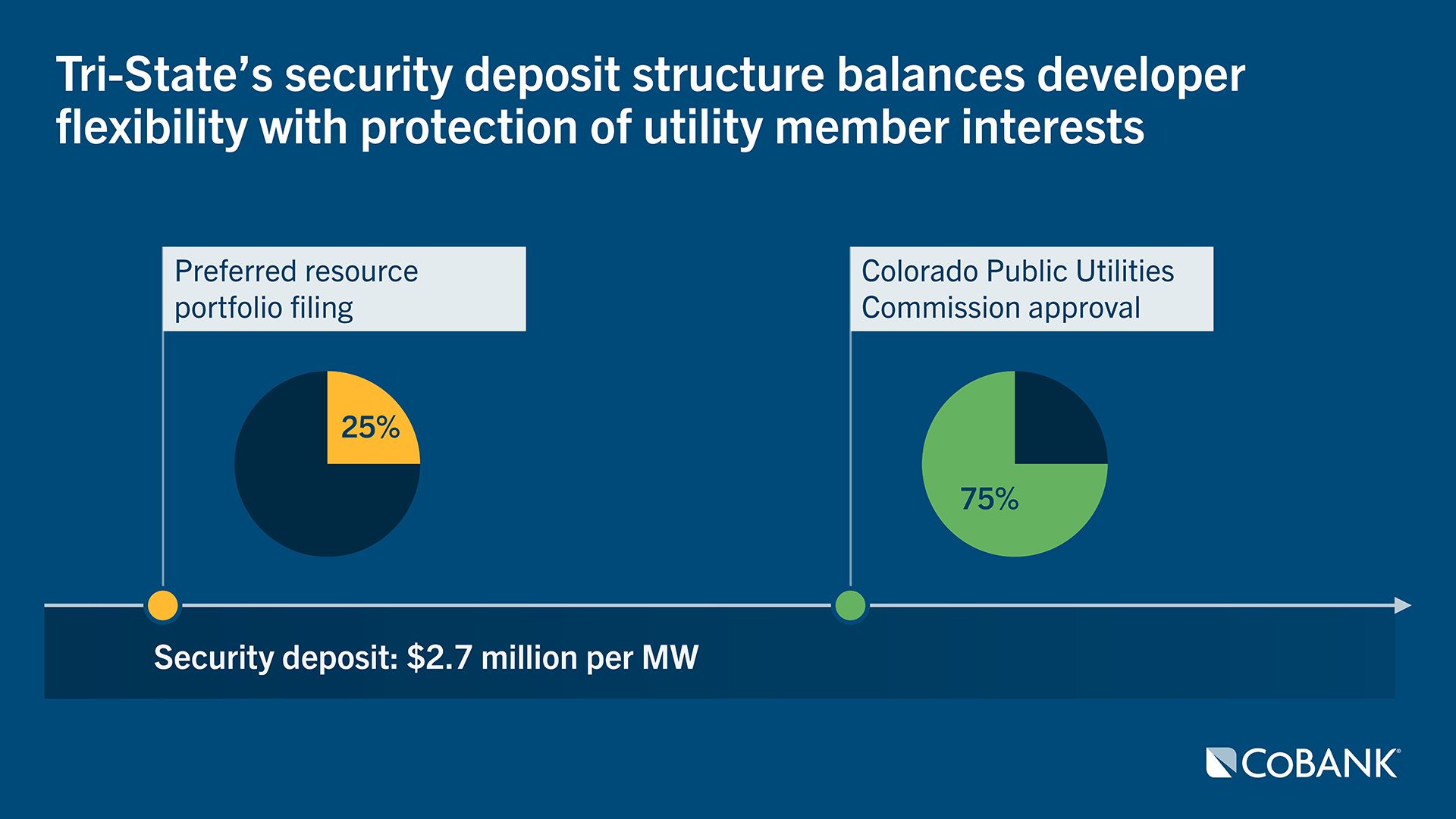
Among Tri-State’s innovations, the security deposit structure stands out as a means of protecting communities from stranded assets in the event a developer fails to deliver. The deposit, set at $2.7 million per MW, is likely the highest in the country and is staged — 25% is due at the preferred resource portfolio filing and the remaining 75% after Colorado Public Utilities Commission approval of the preferred resource portfolio. The approach balances developer flexibility with the need to protect Utility Member interests. In addition, Tri-State’s “Bring Your Own Resource” (BYOR) program enables an alternative option for a member to self-supply up to 100% of the generation requirements for the high-impact load, allowing the high security fee to be waived. This innovative program leverages additional upstream resources and could conceivably accelerate project timelines while maintaining system reliability.
Other contract warranties included in these master contracts are the strict compliance with load obligations. Even with rigorous load-factor guarantees, data center growth often occurs in stages: initial build-out of infrastructure, incremental installation of IT racks, and finally the steady state of full rack density. If the ramp-up schedule slips, the utility must continually reevaluate its resource plan, potentially delaying or accelerating generation commitments to avoid overbuilding or underbuilding. That mismatch between load realization and resource procurement can lead to capacity shortfalls or unnecessary spot purchases at premium prices, both of which translate to higher costs for all customers. Consequently, rather than specifying a discrete ramp window, there are relatively strict requirements: the project’s initial load ramp projection cannot exceed a 5% tolerance band for each of successive three-year updates to preserve the integrity of resource planning.
Tri-State's novel billing safeguards require high-impact load applicants to select minimum demand and energy thresholds, which ensure that rate impacts are predictable and measurable.
Additionally, novel billing safeguards require applicants to select minimum demand and energy thresholds, such as 90% demand with 75% energy or 75% energy with 50% demand, ensuring that rate impacts are predictable and measurable. These thresholds are contractually binding and are evaluated for affordability. Any direct transmission costs are assigned to the customer, preventing financial burdens from shifting to the broader Tri-State membership.
In the event of early termination, Tri-State will calculate the associated costs — including unrecovered minimum charges, resource commitments, and other expenses incurred to serve the project — and may draw on the full security deposit to cover these costs. Early termination events are defined to insulate the membership and may occur if monthly minimum demand fails to reach a 90% project threshold within 180 days of the expected start date, the load exceeds ramp projections, or generation or transmission costs surpass evaluation estimates by over 10%.
Overall, Tri-State’s cost-allocation approach in working with its members to serve high-impact loads is firmly anchored in measurable metrics that align with its mission of reliability, affordability, and responsibility. As Lisa points out, “these principles are not merely aspirational but are embedded in both the evaluation and contract structures for their high-impact loads.”
Ensuring data center costs are not transferred upstream — what would Bonbright do?
There are a host of reasons that make upstream generation and transmission cost allocation challenging — existing and emerging regulatory constructs, multi-jurisdictional complexity, outdated cost recovery models, timing mismatches, stranded asset risk and a lack of transparency. These challenges often result in costs being spread across all customers rather than assigned to the data centers driving the need for new infrastructure. There is ongoing debate about whether and how to “ring-fence” or protect retail customers from these impacts. Tri-State makes an earnest attempt at assigning upstream costs to high-impact loads where there is a direct linkage.
HILT and associated agreements were structured so that any direct transmission costs required to serve a high impact load are assigned specifically to that customer. This means that if new transmission lines, substations, or upgrades result in direct assigned costs to Tri-State because of the high-impact load, those costs are not spread across all Tri-State members. Tri-State proposed using a Facilities Construction Agreement (FCA) between itself and the participating Utility Member for load related transmission interconnection facilities and upgrades. The important distinction, made in the FERC testimony provided by Tri-State’s Vice President Transmission Planning and Policy Ryan Hubbard, is that while “sole use facilities” can be directly assigned to data centers, network upgrade costs are ultimately paid by all transmission customers on a load ratio share basis.
Tri-State's agreements follow the Bonbright Principles of Ratemaking, focusing on cost recovery, fairness and efficiency.
What about new generation? Tri-State offers the flexibility that the new generation, required to meet the large emerging loads, can be supplied by the Utility Member working with its member customer through the BYOR Tariff or obtained directly by Tri-State through regulated resource planning and acquisition processes leveraging either traditional long-term power purchase agreements or construction. In both cases, these new generation costs will be spread to the membership, which is why the high-impact load process conditions Tri-State’s approval on the ability to procure generation and transmission resources in a manner that maintains established affordability criteria. Ultimately the resources acquired by Tri-State through BYOR or regulated resource planning processes will be available to serve the system as a whole, inclusive of successful high-impact loads and will do so in the most affordable manner. In essence, Tri-State’s resource planning affordability mechanism is its version of a protective “ring fence” for the existing membership.
The well-established Bonbright principle for cost allocation means that utility costs should be assigned to the customers who either cause those costs or directly benefit from them. This ensures fairness, transparency, and efficient use of utility resources. If a data center’s connection to the grid requires a new substation or transmission line, the Bonbright principle would assign those costs to the data center, not to all ratepayers. If a new transmission or generation benefits all customers (e.g., improving reliability system-wide), costs may be spread more broadly.
The importance of a coordinated path forward for serving large loads
While not necessarily easy, allocating certain data center costs at the distribution level is very “do-able” because the infrastructure is dedicated, the causality is clear and regulatory rules support direct assignment. Direct allocation upstream is much more difficult due to the networked nature of transmission and generation, complex regulatory environment and risk-sharing.
Shared, networked infrastructure
Transmission lines and generation resources serve many customers across wide regions. When a data center triggers the need for upgrades or new generation, it’s difficult to determine exactly how much the cost is attributable to that one customer versus the broader system.
Regulatory and jurisdictional complexity
Transmission and generation are regulated at the federal and multi-state level, with cost allocation rules that often “socialize” costs across all users. There are fewer mechanisms for direct assignment, and regulatory gaps can make it unclear who should pay.
Cost recovery models not (currently) designed for mega-loads
Traditional models assume gradual, system-wide growth, not sudden, massive demand from a single customer. This makes it hard to “ring-fence” costs for just the triggering data center.
That said, there are important lessons learned on the distribution front that can and should be applied upstream. Distribution costs have accounted for roughly two-thirds of the increase in average consumer prices over the past decade. Emerging big electricity consumers are enabling distribution utilities to spread their fixed costs over a higher sales volume and increase utility revenue. The same could be said about spreading necessary upstream costs across these large loads, as load ratios would ensure that the bulk of these costs are properly accounted for.
The lessons learned from Tri-State’s process provide valuable guidance for other utilities facing similar challenges in a rapidly evolving energy landscape. As Lisa Tiffin emphasized in her FERC testimony, “maintaining affordability is crucial so that end-use customers can benefit from electrification and the transition to a clean energy grid all while preserving service reliability.”
Disclaimer: The information provided in this report is not intended to be investment, tax, or legal advice and should not be relied upon by recipients for such purposes. The information contained in this report has been compiled from what CoBank regards as reliable sources. However, CoBank does not make any representation or warranty regarding the content, and disclaims any responsibility for the information, materials, third-party opinions, and data included in this report. In no event will CoBank be liable for any decision made or actions taken by any person or persons relying on the information contained in this report.